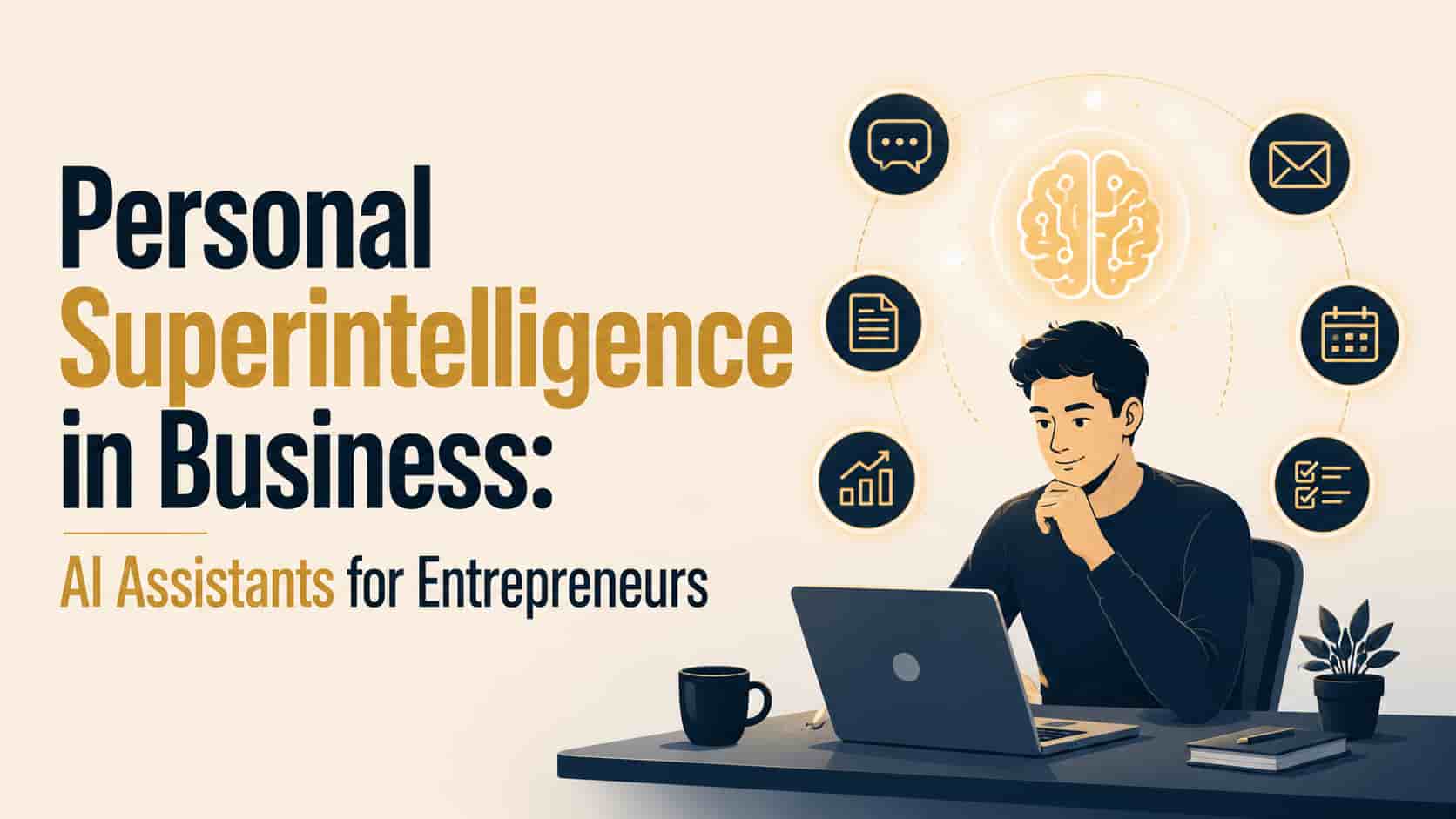
Imagine your own virtual business coach — one that never sleeps, never forgets a detail about your goals, and never charges by the hour. That’s the pitch behind “personal superintelligence,” a phrase Mark Zuckerberg planted firmly in the AI conversation with a lengthy essay called “The Future Is for Everyone,” published on August 10, 2026. It’s a bold contrast to the generic AI assistant you’ve probably already tried — the one that answers a question and then forgets you exist the second you close the tab.
So what does personal superintelligence actually mean for someone running a business, and is it worth paying attention to yet? Here’s the honest answer: parts of it are already usable today, parts of it are still marketing language dressed up as a manifesto, and telling the difference is exactly what this guide is for. Let’s break it down without the corporate jargon.
In this article
Defining Personal Superintelligence
In plain terms, personal superintelligence is the idea that every individual — not just big companies — should have access to an exceptionally capable AI agent built around them specifically. Zuckerberg described it as an agent that understands you, your goals, and everything you care about, working continuously on your behalf across your career, finances, relationships, and daily life.
Here’s the part worth clarifying, because it gets muddled a lot: this isn’t the same thing as AGI, and it isn’t one centralized super-brain running the world from a server farm somewhere. The whole philosophy actually argues against that — Zuckerberg’s essay explicitly pushes back on the idea of a single, all-knowing AI system, framing it instead as millions of individually directed agents, each working for the person who owns it.
Whether that vision holds up in practice is a fair question — Pixel Envy’s response to the essay points out how vague the framing still is, and how much of it depends on trusting one company with an enormous amount of personal data. That skepticism is worth keeping in mind as you read the rest of this.
How It Differs from Today’s AI
Compare that vision to the AI you’re already using. Tools like ChatGPT or Siri are mostly reactive — you ask, they answer, and the context resets soon after. Useful, sure, but closer to a very smart search bar than an assistant that actually knows your business.
Personal superintelligence, at least as Meta is building toward it, points somewhere different: multimodal reasoning (text, voice, images, all in one conversation), genuine tool-use (an agent that can actually take an action instead of just describing how), and personalization that accumulates over time instead of resetting every session. The difference isn’t really about raw intelligence — today’s leading chatbots are already remarkably capable. It’s about memory and initiative: an assistant that remembers your business context from last week without you re-explaining it, and one that can go do something on your behalf rather than just telling you the steps.
Meta’s own underlying model for this, called Muse Spark, is explicitly described by the company as the first step on a scaling path toward that broader personal superintelligence goal — built for multi-agent orchestration and tool-use rather than single-turn Q&A. Other major AI providers are racing down a similar road with their own agentic and multimodal features, so this isn’t a Meta-only story — it’s the direction the whole industry is leaning, and worth watching regardless of which company ends up ahead.
Benefits for Entrepreneurs
Goal Achievement
A capable AI assistant can do more than answer questions — it can help you actually plan. Give it your quarter’s goals and it can break them into weekly tasks, set up reminders, and brainstorm angles you hadn’t considered. Stuck on a launch date or a pricing decision? Talk it through out loud, so to speak, and let it push back on your assumptions the way a good business partner would. Think of it less like a search engine and more like a project manager who’s read every book on your industry and never gets tired of your questions.
Personalized Insights
Feed an AI assistant your sales numbers, customer feedback, or market research, and it can spot patterns you’d otherwise miss buried in a spreadsheet — which products cluster together in the same orders, which complaint shows up right before a customer churns, which traffic source actually converts instead of just clicking through. This is where the “personal” part earns its keep. Generic advice is everywhere online, but insights built from your actual numbers are what move the needle, and it’s the difference between a blog post that says “improve retention” and an assistant that tells you exactly where your retention is leaking.
Learning and Growth
Maybe the most underrated use case: a good AI assistant can function as a tutor with infinite patience, walking you through a skill gap — pricing strategy, a new marketing channel, basic financial modeling — on your own schedule, at your own pace, without the awkwardness of admitting to a mentor that you don’t already know this. The best version of this genuinely helps you become the person your business needs you to be, one weekend project at a time.
Real-World Use Cases
Consider a freelance marketer in the UK who set up a custom GPT trained on her past campaign briefs and client tone-of-voice guides. Instead of starting every project from a blank page, she now starts from a draft that already sounds like her — cutting her research and first-draft time dramatically, which means she can take on an extra client or two each month without working extra weekends to do it.
Or a startup founder in India using an AI research agent to interview simulated customer personas before committing budget to a new feature — testing messaging and objections in an afternoon instead of over weeks of manual customer interviews. It’s not a replacement for talking to real customers eventually, but it’s a fast, cheap way to catch an obviously bad idea before it costs you a development sprint. Tools like custom GPTs and Google’s Gemini-powered agents in Workspace are already making this kind of personalized, ongoing AI relationship possible today, even before “true” personal superintelligence fully arrives.
Getting Started Today
You don’t need to wait for the futuristic version to start benefiting. Here’s where to begin:
- Start with what’s free. Try ChatGPT’s custom GPTs, Meta AI in the Meta AI app, or Gemini inside Google Workspace if you’re already in that ecosystem.
- Feed it real context. Upload your business plan, past client emails, or brand guidelines instead of asking generic questions.
- Build the habit gradually. Add a little more personal and business context each week rather than trying to hand over everything on day one.
- Watch the space. Meta, OpenAI, and Google are all shipping new agentic features at a rapid clip — what’s a limitation today may not be next quarter.
More from the author:
Zuckerberg’s “Personal Superintelligence” Essay — What It Really Means for Your AI Side Income in 2026
10 Wealth-Building Quotes From Billionaires (With Guided Prompts)
Challenges and Ethics
None of this comes free of trade-offs. Personal superintelligence, by definition, means handing an AI provider a lot of personal and business data — your goals, your finances, your habits, your customer lists. Before you go all-in, check what a provider actually does with that information, whether it’s used to train future models, and whether you can opt out. This matters even more if you’re a Meta skeptic specifically — the company’s track record on privacy is a legitimate reason some entrepreneurs will choose a different provider entirely, and that’s a completely reasonable call to make.
Model reliability is the other piece: even the most advanced assistant can get things wrong confidently, stating a made-up statistic or a wrong deadline with total conviction. Treat AI output as a strong first draft from a very fast, very well-read intern — not a final answer you forward to a client untouched. Human oversight isn’t optional here; it’s the whole point of staying in control of the tool instead of the other way around.
What’s in a Nutshell
Personal superintelligence is still an unfolding story, not a finished product — and healthy skepticism about who’s building it and why is completely reasonable, especially given how many “vision” essays big tech companies have published over the years that didn’t quite pan out as promised. But the underlying shift is real: AI assistants are moving from reactive tools toward genuine, ongoing collaborators that amplify what one person can do, rather than replacing the judgment only you can bring.
For entrepreneurs, that’s the real opportunity — routine work handled in the background while you focus on the creative, relationship-driven decisions that actually grow a business. Try building even a lightweight version of this into your workflow this month, and see how much time it actually frees up.