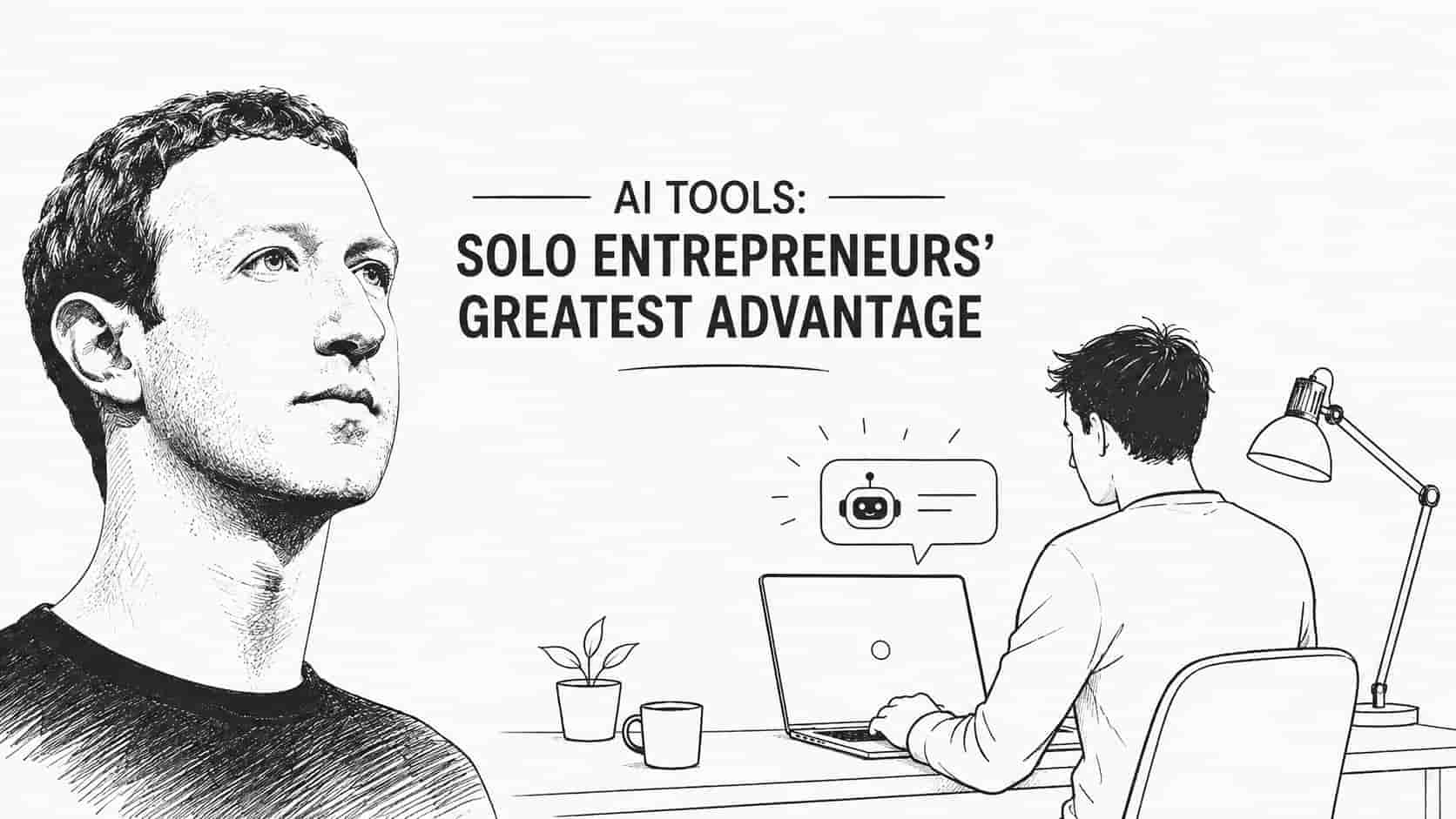
I was scrolling through Facebook last night, half-paying attention, when a long post from Mark Zuckerberg stopped my thumb. Not a photo, not a video — just paragraph after paragraph on where he thinks AI is headed, and who he thinks should get to use it. Dated August 10, 2026, the piece lays out a philosophy he’s calling “personal superintelligence,” and underneath the big-picture language about geopolitics and safety, there’s a much more personal question buried in there: who actually gets to benefit from all this power, you or a handful of institutions?
That question is exactly why I write in this category. I’m not interested in AI as a spectator sport. I’m interested in what it means for the person reading this on their lunch break, wondering if there’s a way to build something of their own with the tools sitting right in front of them. So let’s unpack what Zuckerberg is actually proposing, strip away the corporate framing, and get to the part that matters most: what any of us with a laptop and an idea can do with it right now.
In this article
The Core Idea, in Plain Language
Strip the essay down, and the argument is fairly simple. Zuckerberg believes the biggest risk with advanced AI isn’t the technology itself — it’s who controls it. If only a few companies or governments hold the most capable systems, power concentrates upward. But if powerful AI is spread widely, so individuals can direct it toward their own goals, power stays distributed — the way it has, historically, whenever new tools moved from institutions into ordinary people’s hands.
He points to a few examples that will feel familiar: the personal computer moving out of research labs and onto desks, the internet moving from universities into homes. His bet is that AI follows the same arc — from something only big companies can afford to use effectively, to something every person carries in their pocket and directs toward their own life.
He also draws a distinction that’s worth sitting with even if you never think about Meta again after today: the difference between AI that automates you out of a task, and AI that hands you tools to invent something new. Automation replaces effort. Invention multiplies it. One shrinks your role; the other expands it. That distinction is the entire reason this category of my site exists — I’m far more interested in the second kind of AI than the first.
There’s also a version of the essay’s argument that applies whether or not you buy into the “superintelligence” branding at all. Strip away the futurism, and the underlying claim is almost mundane: tools that used to require a team, a budget, and months of lead time are being compressed into something one motivated person can operate from a laptop. That compression is the actual story. Whether you call the endpoint “superintelligence” or just “a very capable assistant” doesn’t change what it means for someone trying to build an income stream on the side.
Why This Isn’t Just a “Someday” Story
It would be easy to read an essay like this and file it under “interesting, but years away.” I’d push back on that. The version of “personal superintelligence” available to an ordinary person in 2026 is already startlingly capable compared to what existed even eighteen months ago. You don’t need to wait for some future breakthrough to put this philosophy into practice — the tools for a one-person business to punch far above its size already exist, and most people simply haven’t picked them up yet.
That gap — between what’s available and what’s actually being used — is where the opportunity sits. Big companies have research teams evaluating every new AI capability the week it ships. Most individuals and small business owners are still using AI the way they used a search engine three years ago: a quick question here, a paragraph rewritten there. The businesses and side incomes that grow fastest over the next few years won’t necessarily belong to the most talented people. They’ll belong to the people who close that gap first.
The Toolkit Already Sitting in Front of You
Before getting into strategy, it’s worth naming what “personal superintelligence” actually looks like in practice today, because it isn’t one product — it’s a stack of them, and most people are only using one layer.
There are general-purpose reasoning assistants that can hold context about your business across a long conversation, help you think through pricing, or draft a difficult email to a client. There are image and design tools that can take you from a rough concept to a usable logo, cover, or ad creative in minutes rather than days. There are coding assistants that let someone with no formal programming background put together a working website, a simple app, or an automation script through plain-language instructions. And there are research and analysis tools that can digest a spreadsheet, a stack of reviews, or a competitor’s site and hand you back a structured summary instead of hours of manual reading.
None of these are exotic anymore. Most have genuinely usable free tiers. The shift isn’t access — it’s whether you’ve built the habit of reaching for them before you reach for the slow, manual way of doing things. That habit, more than any specific tool, is what separates people who talk about AI from people who quietly build with it.
Six Ways to Put This Philosophy to Work
Here’s where I want to move from Zuckerberg’s essay to something you can actually use this week.
1. Treat AI like a co-founder, not a search bar. Most people ask AI tools for isolated answers — a headline, a paragraph, a summary — and stop there. A more useful habit is giving an AI tool ongoing context about your business: your audience, your voice, your goals, your constraints. Paste in your business plan. Explain your ideal customer in detail. Ask it to challenge your assumptions, not just execute your requests. The quality of what you get back scales directly with how much real context you’re willing to hand over.
2. Build a “one-person product studio.” A phrase that stuck with me from the broader conversation around this essay is the idea that individuals can now manifest ideas without raising money or building teams. That’s not hype — it’s the practical reality of tools that can help you write code, design a logo, draft a legal disclaimer, and produce marketing copy, all before lunch. If you have a product idea sitting in a notes app, the barrier to a rough working version has dropped further than most people realize. A digital planner, a niche newsletter, a small SaaS tool, a print-on-demand line — all of these are more buildable solo today than they were even a year ago.
3. Automate the parts of your business that don’t need you. Every small business has a layer of repetitive work — answering the same customer questions, formatting the same reports, scheduling the same types of posts. This is the “automation” half of the equation, and it’s genuinely valuable when it’s aimed at tasks you never wanted to do in the first place. The goal isn’t to remove yourself from your business; it’s to remove the parts of your week that were never really building anything.
4. Use AI as a research analyst for your niche. Before you build anything, you need to know if anyone wants it. AI tools are remarkably good at helping you stress-test an idea — summarizing competitor positioning, drafting customer interview questions, spotting gaps in a market you’re considering. I’d treat this as a non-negotiable first step for any new income stream, not an afterthought. Ten minutes of structured questioning can save you weeks of building the wrong thing.
5. Turn yourself into a “tutor with a PhD” for your own skill gaps. One of the more compelling ideas in the broader conversation is that AI tools can function like a patient, always-available teacher. If there’s a skill standing between you and your next income stream — copywriting, basic design, spreadsheet modeling, a new platform’s algorithm — that skill is more learnable right now, on your own schedule, than at almost any point before. Don’t outsource the thing you could learn to do yourself in a weekend; use AI to close that gap instead.
6. Start free, then scale into paid tools deliberately. The essay makes a point of arguing that broad access matters — that free or low-cost tiers of powerful AI should reach as many people as possible, not just those who can afford enterprise pricing. Whatever you think of the specifics, the underlying reality is true today: you can build a genuinely useful proof of concept using free tiers of AI writing, image, and coding tools. Reserve your budget for the moment you have evidence something is working, not before.
The Honest Caveats
I’d be doing you a disservice if I only handed you the optimistic version. A few things are worth holding onto as you build:
- “Easy to start” isn’t the same as “easy to succeed.” AI lowers the barrier to producing something. It doesn’t lower the barrier to marketing it, pricing it, or standing behind it when a customer has a problem. The business fundamentals haven’t changed — only the cost of the first draft.
- Everyone has the same tools, which raises the bar. If AI genuinely puts capable tools in everyone’s hands, the differentiator stops being “can you produce this at all” and becomes “can you produce this with genuine taste, judgment, and a point of view.” That’s worth sitting with before you assume the playing field just got easier for you specifically.
- Skills still compound. The essay’s framing treats AI mostly as a multiplier of individual capability. A multiplier works best on something that already has value. Spend time building real expertise in your niche — AI amplifies it far more than it replaces the need for it.
A Simple Starting Checklist
If this piece has you wanting to move rather than just nod along, here’s where I’d start this week:
- Pick one repetitive task in your current work or side project and hand it fully to an AI tool for a week.
- Write out, in detail, who your ideal customer is — and feed that context into every AI conversation about your business going forward.
- Ask an AI tool to poke holes in your current business idea before you build another feature.
- Identify the one skill gap that’s actually holding you back, and spend one weekend closing it with AI as your tutor.
- Build the smallest possible version of your idea using only free tools before spending a dollar.
A Few Questions Worth Answering Directly
Do I need to understand the technical side of AI to use it for income?
No. Every strategy above uses plain-language instructions, not code or model training. The skill that matters is knowing your business well enough to give the tool useful context — not knowing how the tool works internally.
Is it too late — hasn’t everyone already figured this out?
Not even close. Most small business owners I talk to are still using AI for occasional, isolated tasks rather than as an ongoing part of how they research, build, and operate. The gap between availability and actual use is still wide, which is exactly why there’s still room to move early.
What if I don’t have a business idea yet?
Start with strategy four — use AI as a research analyst to explore problems you already notice in your daily life or work. A concrete, well-researched problem is a better starting point than a search for “an idea.“
Should I be worried about AI replacing what I’m trying to build?
It’s a fair concern, and the honest answer is that it depends heavily on the niche. The safer bet, based on everything I’ve seen, is to build around your judgment, taste, and relationships with customers — the parts of a business that are hardest to automate — and let AI handle the production layer underneath that.
Where I Land on All of This
Whatever you make of Zuckerberg‘s broader vision — and there’s plenty in that essay worth debating, especially around how much trust any single company deserves with this much influence — the underlying invitation is one I happen to agree with: the tools are here, they’re more capable than most people are using them for, and the gap between “available” and “used” is where the real opportunity is sitting right now.
I’ll keep covering practical, no-hype ways to use AI to build real income in this category. If you’re just getting started and want a structured way to think about money, tools, and building something of your own, it pairs well with the ideas I explore in The Psychology of Spending — subscribe or check back here for the next piece in this series.
— S S Dhar
Also read: 5 Wealth-Building Rules I Learned as a Graduate Living Paycheck to Paycheck
Reference
Here is the original post by Zuckerberg