An excerpt-inspired reflection from my book The Philosophy of Loving the World
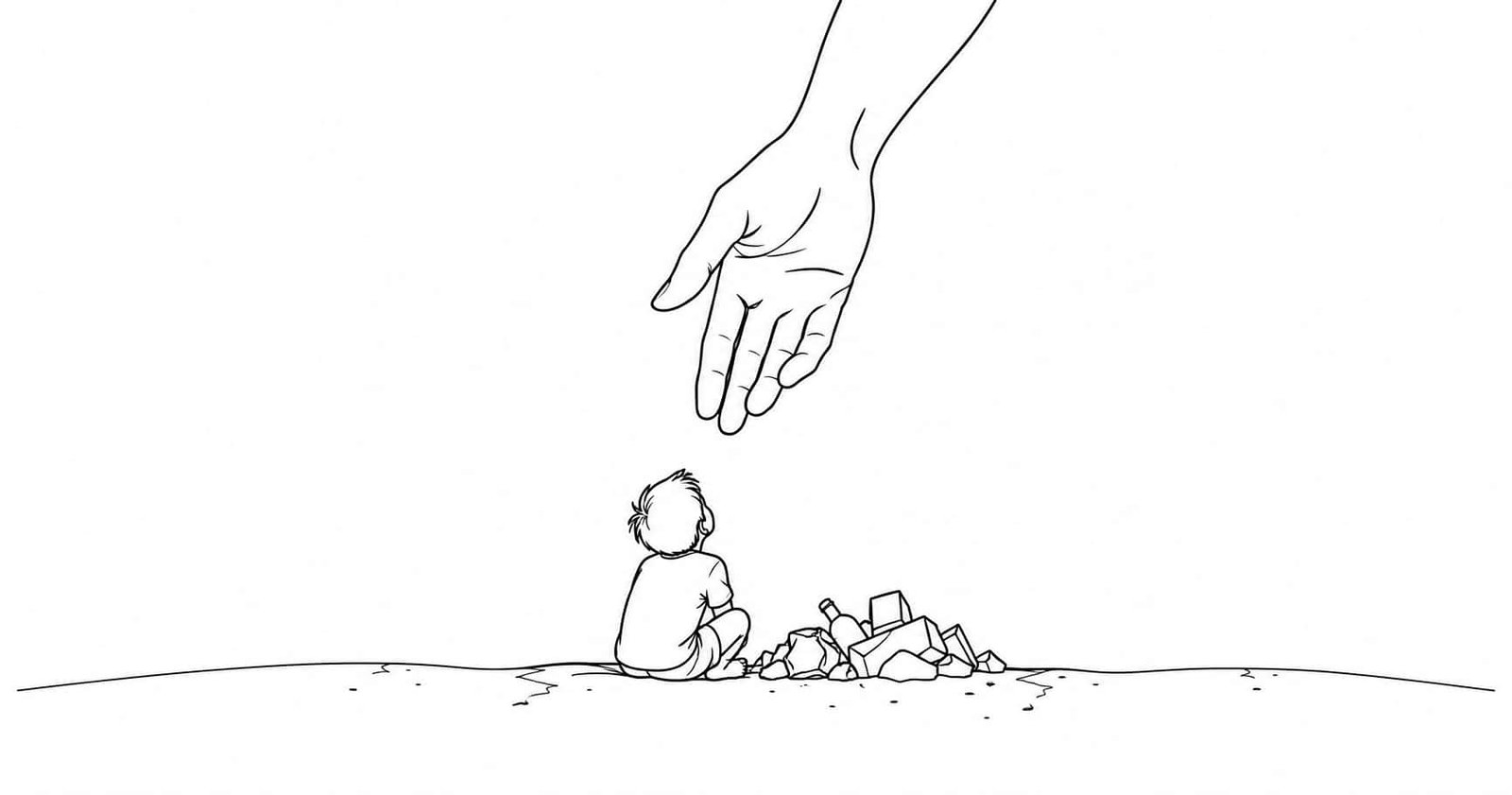
Some poems come from imagination. Others come from a wound that will not close. “The Barest Means” belongs to the second kind. It began with a simple image I could not stop seeing: a hungry child, crying, creeping toward a heap of waste because it is the only place left to look for survival.
In this article, I want to walk through the poem, explain what I was trying to say, and ask the question I believe every religion and every science eventually asks: if we can see the child, why do we so often fail to act?
In this article
The Poem
The Barest Means
See the child.
See the hunger in his appearance.
See the poverty line
carved deep into the borders of the world.See the child, crying,
creeping slowly toward the heaps of waste.
He weeps with an ever-resisting persistence.
To whom can he show his anger?
To whom can he make his desperate plea?
To whom can he show what lies inside him?There is only a polluted earth
holding him in her toxic lap.
There is only a silent God
guiding his survival
by the barest means.But there are people,
tender, merciful hearts
who want to lend a gracious hand.
Yet the weight of their own ambitions
has made them forget what is sacred
and will not let their hearts open.
“See the Child”: The Poem as a Command to Look
The poem opens with an instruction, repeated three times: see. Poverty is rarely hidden. It is simply unseen, because we have trained ourselves to look past it. The first stanza asks the reader to stop scrolling past the statistic and meet the face.
The phrase “poverty line carved deep into the borders of the world” is deliberate. A poverty line is a number on a chart, drawn by economists. But a border is something that divides people. I wanted to suggest that the line is not only economic. It is a boundary we have cut across the planet, with some of us on the comfortable side and some of us left outside it.
Three Questions Nobody Answers
In the second stanza, the child asks, without words, three questions. To whom can he show his anger? To whom can he make his plea? To whom can he show what lies inside him?
These are really one question: who is listening? A child in that position has no voice in any parliament, no seat in any boardroom, no access to any court. His persistence, the “ever-resisting persistence” of his weeping, is the only language he has. And the poem admits an uncomfortable truth: the world mostly does not answer.
A Polluted Earth and a Silent God
The third stanza is where science and spirituality meet.
On the scientific side, the image of the earth holding the child “in her toxic lap” is not poetic exaggeration. Environmental research has long shown that the burden of pollution, contaminated water, poor air and unmanaged waste falls hardest on the poorest communities. Children who live near waste sites and who scavenge for a living face the greatest exposure to harm, while contributing the least to the damage. The earth that should nurture him has been made unsafe by choices he never took part in.
On the spiritual side, I wrote of “a silent God guiding his survival by the barest means.” I want to be careful here, because this line can be read two ways. It can sound like an accusation: where is God while a child suffers? It can also sound like faith at its most stripped-down: even in the worst conditions, something keeps this child alive. I intentionally left both readings open. The silence of God is one of the oldest questions in every tradition, and I do not think a poem should pretend to solve it.
But here is the thought that moves me most. If God is silent, then perhaps God speaks through us, or is meant to. The silence may not be an absence. It may be a waiting.
What the Great Traditions Say About Hunger
I have always believed that the world’s scriptures, whatever their differences, agree more than they disagree on one point: the hungry must be fed.
- The Bible. In the Gospel of Matthew, Jesus teaches that what we do for the hungry and the least among us, we do for him. Service to the poor is treated as service to the divine.
- The Bhagavad Gita. In its twelfth chapter, the devotee dear to God is described as one who bears no hatred toward any being and is friendly and compassionate to all. Compassion is not an extra; it is the mark of the awakened person.
- The Quran. Surah Al-Ma’un warns against those who ignore the orphan and do not encourage the feeding of the needy, and Surah Al-Balad praises feeding the hungry on a day of hardship.
Different languages, different centuries, one message. No tradition I know of tells us to look away.
The Final Stanza: Why Good People Do Not Help
The last stanza is the one I consider the heart of the poem, and the one that turns the mirror toward us.
I did not write about cruel people. I wrote about tender, merciful hearts who want to help. Most of us are like this. We feel moved. We intend to give, to volunteer, to do something. And then the weight of our own ambitions, deadlines, goals and comparisons presses down, and the intention fades.
That is the tragedy I wanted to name. The problem is not a shortage of kindness. It is that ambition, unexamined, makes us forget what is sacred. The heart does not close because we hate. It closes because we are busy.
This connects to the theme of integrity that runs through my work. Integrity is not only honesty in speech. It is the alignment between what we say we value and how we actually live. A person who weeps at the sight of a hungry child and then returns unchanged to their routine has a gap between feeling and action. The poem asks us to close that gap.
What Can We Actually Do?
A poem that only accuses is incomplete. So here are a few small, honest starting points:
- Give locally and consistently. A regular small contribution to a trusted food or child-welfare organisation does more than an occasional grand gesture.
- Reduce waste. Every meal thrown away and every unnecessary product bought connects, in a small way, to the heaps of waste in the poem.
- Teach children to see. Take young people to serve meals, not just to observe. Compassion is learned by practice.
- Protect your own softness. Notice the moment your heart begins to open and do not talk yourself out of it. Act within the day.
Reflection
I wrote “The Barest Means” not to make readers feel guilty, but to make them feel awake. The child in the poem is every child who survives on the margins of our attention. The question is not whether God is silent. The question is whether we are listening, and whether we are willing to be the answer to a prayer we were never asked to overhear.
If this poem stirred something in you, I invite you to read more in my book, The Philosophy of Loving the World, and to share this article with someone who might need the reminder to open their heart.
What did the poem make you feel? I would be glad to hear your thoughts in the comments.
Link to the Book
Available on Amazon: Amazon US | Amazon UK | Amazon CA | Amazon AU | Amazon IN and other Amazon marketplaces.
Other Philosophical Articles on This Book
- Peace Within, Peace Around Us
- Borders as Doorways: Loving Your Nation and the World
- The Shadow Self: Why Love Begins With What We Hide
- Why I Wrote The Philosophy of Loving the World
- The Earthitism Manifesto
FAQs
What is the poem “The Barest Means” about?
“The Barest Means” is a poem about a hungry child living in extreme poverty, forced to search through heaps of waste to survive. It looks at the suffering of the poor, the pollution of the earth, the apparent silence of God, and the way good people, weighed down by their own ambitions, fail to open their hearts and help. The poem is from my book, The Philosophy of Loving the World.
What does the “silent God” in the poem mean?
The line can be read in two ways. It can express the painful question of why God seems absent when a child suffers, or it can express a stripped-down faith that something still keeps the child alive, even “by the barest means.” I left both readings open on purpose. Many readers also take it as a call to action: if God is silent, compassion may be meant to speak through us.
Why does the poem blame ambition rather than cruelty?
Because most people who ignore poverty are not cruel; they are busy. The final stanza describes tender, merciful hearts that want to help, yet the weight of ambition makes them forget what is sacred. The poem suggests that the real barrier to compassion is distraction and self-focus, not hatred, and that integrity means aligning what we feel with how we act.