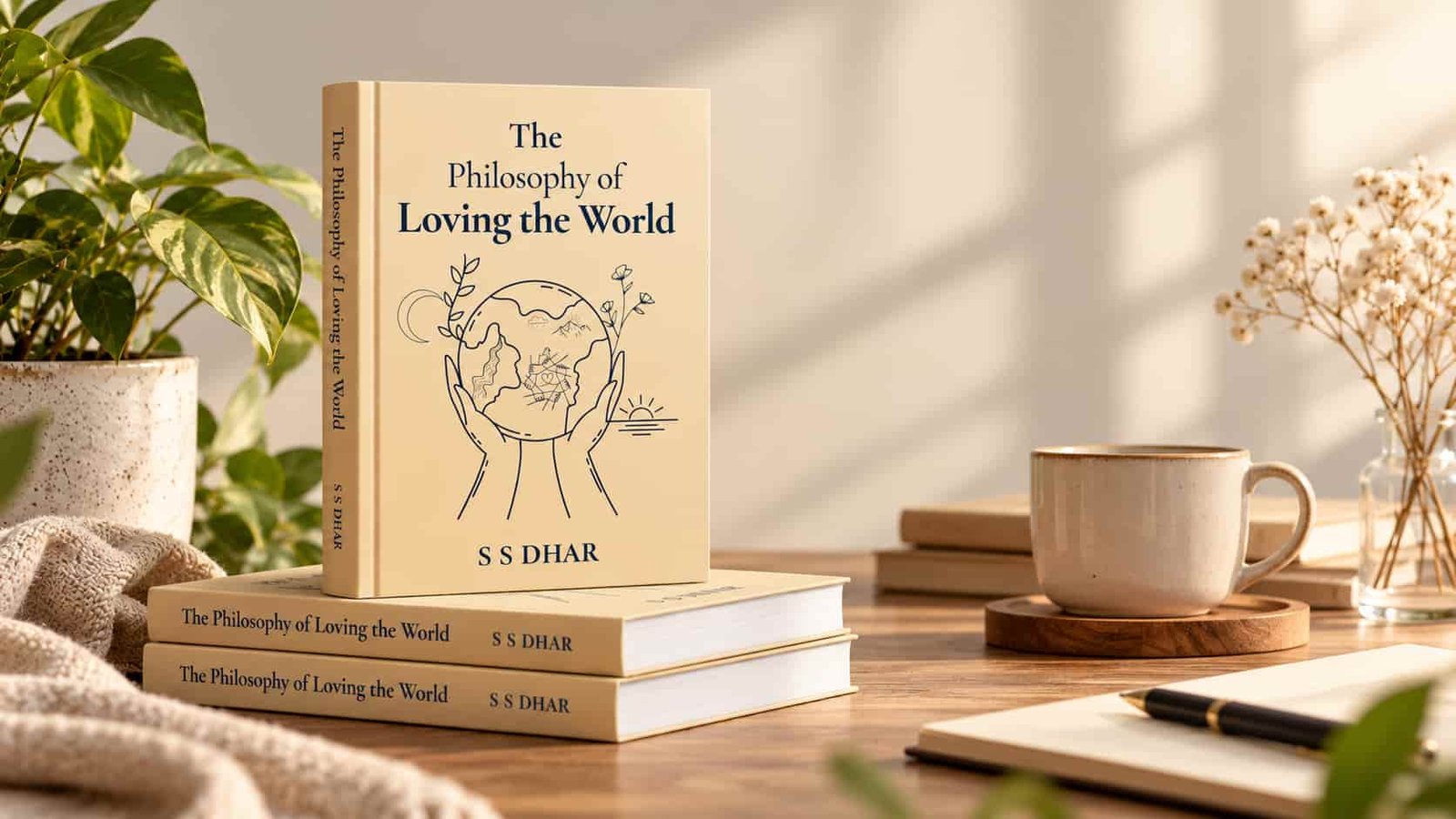
I wrote this book because of one belief: the world needs love, joy, peace, and abundance under one roof. This is the simple reason to write the book The Philosophy of Loving the World.
It sounds simple, perhaps too simple. But listen to what the world talks about most. We talk about diplomacy, power, wealth, and war. We talk about who is ahead, who is threatened, and who owns what. We talk far less about whether people are loved, whether they are at peace, and whether everyone has enough. This book began as my attempt to turn that conversation around.
In this article
Where the book begins
Love does not start large. It starts as a small light in one heart. That is the first line of the book, and it shaped everything that follows.
If love begins in one heart, then the honest place to start is the self. But I did not want to stop there. Self-love that stays within gives the world nothing. It only becomes something when a little kindness is added to it, and the self grows into a soul whose footsteps light the way for others. So the book moves outward, one step at a time, like a circle widening.
The six chapters as steps in The Philosophy of Loving the World
The collection is arranged in six chapters, and each one answers a question the one before it raises.
Love for the Self. The book opens here because every other kind of love grows from it. These poems look at birth, at the mind with its many faces, at the inner king who is never crowned, and at the quiet work of becoming the best version of oneself.
The Shadow Self. Self-love is incomplete if it avoids what we hide. This chapter faces the shadow, the part of us that hums a song only when the house is empty. I believe we cannot love others well until we have met this part of ourselves honestly.
Love for Others. Here the book turns outward. Taking is easy and giving is harder, and the poems ask who will be the kind stranger who stays. They speak for the unheard, for the hidden sufferers, and for the children waiting on the horizon.
Love for the Nation. Love of country can open a heart or close one. This chapter asks what a nation owes its people, and what it owes the world. Its central hope is that a country can love others and be loved by others in return.
Love for the Earth. The widest circle in the book is also the one closest to my heart. The Earth appears here as a mother who holds us all, who weeps in secret while her children play with weapons, and whose patience is large but not endless.
Love for Peace. The last chapter brings everything together. Peace begins in the mind and the heart, and it asks us to erase the line we drew between them.
Why poetry?
I could have written an essay or a treatise. I chose poems because some truths are felt before they are understood.
A paragraph can argue that the Earth deserves our care. A poem can make you feel her as a body, with water for her blood, rivers for her veins, and mountain ranges for her spine. A paragraph can say that power does not make us stronger. A poem can ask, “Which war do you want to win?” and leave you sitting with the question.
The poems also vary in length. Some are only a few lines, and some run longer. You can read the book in order, or open it anywhere and begin.
My background, and why it matters here
I studied physics and mathematics in college, and I now write on philosophy, psychology, spirituality, and world peace. People sometimes ask how those fit together. For me, the connection is a way of looking. Physics and mathematics teach you to ask what lies beneath the surface of things, and what the underlying principle is. I try to ask the same questions of human life, and the book is where I wrote down some of the answers I found.
Who the book is for
I wrote it for leaders and teachers, writers and speakers, students and all who learn. I also wrote it for everyone whose heart is big enough to share a part of itself.
The first poem in the Earth chapter makes my hope plain. If even one person can understand these poems and carry them into a speech or a classroom, the world may revive, and living beings may survive in the distant future. Let this be spread, and let all her children be made aware of their mother.
What I hope you take from it
I do not expect a book of poems to end war or poverty. But I believe ideas travel. A line that stays with someone can change how they speak to a neighbor, how they vote, how they teach, or how they treat the ground under their feet. That is how most large changes start: in one heart, and then in another.
The book ends with three questions and no answers. Where will love for the world live if every heart perishes? Where will peace live if every mind holds only fire? I leave them open because the answers belong to the reader.
If you read the book, I hope it leaves you a little more willing to share a part of yourself. And if you have already felt that small light in your own heart, I hope these poems tell you that you are not alone.
The Philosophy of Loving the World is available now on Amazon.
Read the Manifesto of coined terms used in this book: The Earthitism Manifesto