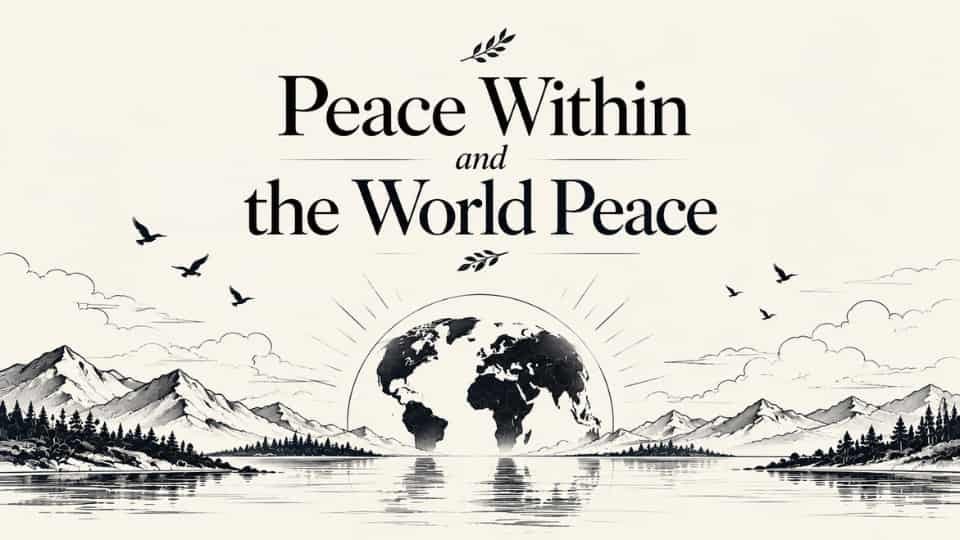
Peace within is where the search for peace begins, and it cannot end there.
The last chapter of my book The Philosophy of Loving the World is called “Love for Peace.” Before its first poem, I placed two short statements. Self-evolution is the spirituality that finds divine peace within. Peace around us is the philosophy of evolving our love until it embraces all humankind. Then a closing line: the one begins in the mind, the other in the heart.
In this article
Everything in the chapter grows from those few lines.
Peace within and the world peace: One task, not two
We usually treat inner peace and world peace as separate subjects. Inner peace belongs to meditation, prayer, and self-help. World peace belongs to diplomats, armies, and summits. Each side tends to look down on the other. The seeker says politics is noise, and the activist says meditation is escape.
I believe both are wrong in the same way. A person who carries war inside cannot build calm outside. And a person who finds calm but looks away from the suffering outside is only protecting a comfortable room. The two peaces are one task, seen from two sides.
That is why one poem in the chapter asks us to erase a line we drew ourselves. We demarcated the human mind from the heart. Let us erase that line and walk toward a horizon of peace, prosperity, and honesty.
It starts with listening
The first poem of the chapter is called “Listen.” It begins with questions. If there is no one to see, what will be seen? If there is no one to sing, what will be sung? If there is no one to feel, what will be felt?
Then it answers them. We are still living here, conscious and responsible for listening to humanity, for listening to the hearts of the world.
I put listening first because peace is rarely broken by a lack of speeches. It is broken by a lack of hearing. The next poem, “The Feeling That Stills,” asks where we will find the feeling that stills every other feeling, and ends with a sentence I believe: the welfare of humanity waits on the approval of your heart.
Guard what remains
Peace is also about what we choose to protect. In “While It Lasts,” I wrote that nothing is priced by its worth, because scarcity decides. Let gold be plentiful and iron rare, and iron will be the treasure. Even air and water, which we cannot live without, cost almost nothing while they last.
The poem then asks what the value of water is if no one is left to drink, or the value of a civilization if there is no population. Its answer is practical: let us guard what remains, and share it peacefully while it lasts.
“Under One Roof” asks a harder question of those who build weapons and technology. What are you building, you creators, that breaks the hearts of your own household? What weapons are you looking for to defend you from outside enemies, when this is your house, and all people are family under its roof?
I do not oppose progress. The same poem tells the creators to build, to develop, and to break every barrier. But the goal is to make the world happier without losing its peace.
The children who are not heard
“Unheard Children” holds the chapter’s moral center. A baby crying in a gilded cradle is soothed, while millions elsewhere cry without being held and dance in the dust through dawn and dusk. Yet a child raised in that hunger might be the one to end hunger. A child raised in that poverty might be the one to end poverty. A child raised in the darkness of illiteracy might bring light to the places that need it most.
I think this is the clearest argument for why peace cannot be only a treaty. A treaty can stop a war. It cannot, by itself, make sure a child is heard. Peace is also whether the quietest voices have a chance to rise.
The disasters we do not name
“The Universal Manifesto” begins by noticing what the world talks about. When a natural disaster peaks, or an economic crisis breaks the market, everyone speaks of nothing else. But what about the philosophical disasters? What about our morality for all humankind, failing? What about the betrayal of peace, love, and integrity among billions, the hollow treaties and promises, the misuse of power and wealth, and our fading belief in humanity?
The poem then speaks to everyone: teachers and students, leaders and bureaucrats, the rich and the poor, the famous and the unknown. Let human beings believe in humanity once more. Let them remember that this earth is the one home of all footprints, and the shared dwelling of every faith, whatever name every human gives to God.
I believe that sentence is the heart of the book.
A question for the gifted
One poem turns the argument on the reader. If your smile does not make others smile, if your wisdom does not make others wise, if your wealth does not relieve the hunger of the starved, forgotten corners of the earth, what are these qualities for? They are meant, I wrote, to be poured out to resurrect humankind.
Anyone with a talent, a platform, or a bit of comfort can ask that question. It is not a question for rulers alone.
Where will peace live?
The chapter closes with three questions and no answers. Where will north, east, west, and south be if the sun loses its way? Where will love for the world live if every heart perishes? Where will peace live if every mind holds only fire?
I left them unanswered on purpose. Peace is not a place on a map. It lives in whoever chooses to keep it alive, one mind and one heart at a time.
If you want to begin, begin where the chapter begins: listen. Then widen your love by one more person than you did yesterday.
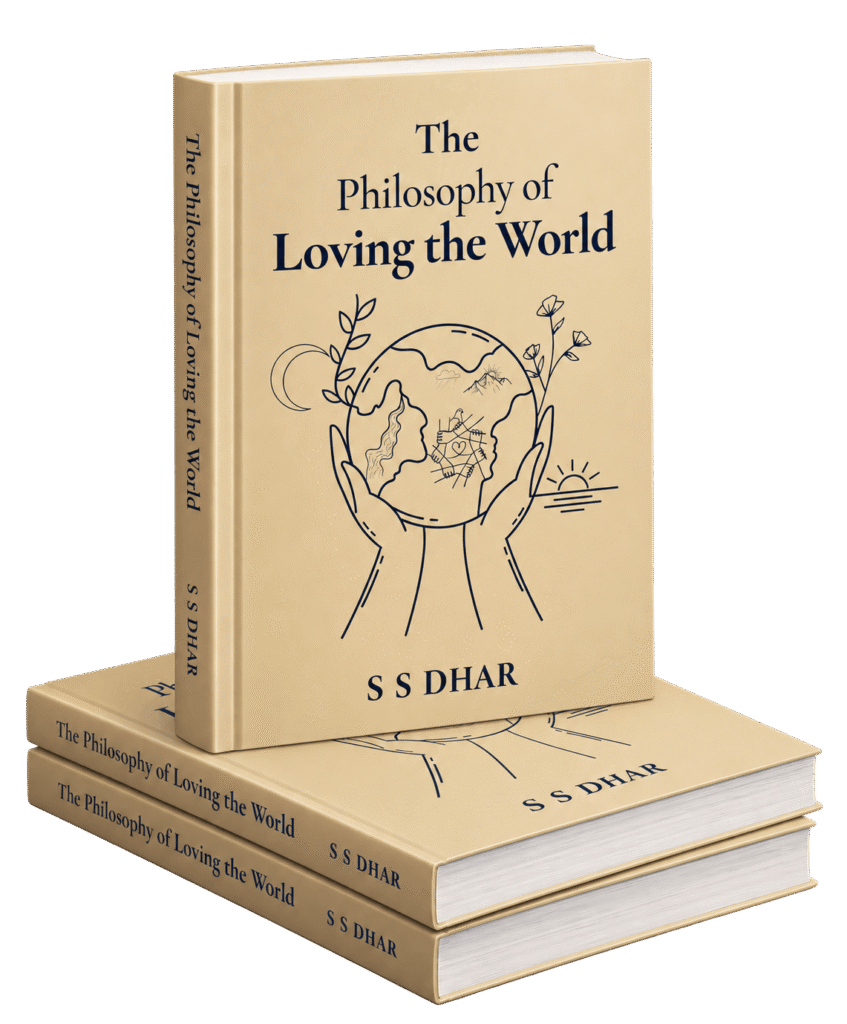
From the chapter “Love for Peace” in The Philosophy of Loving the World. Order your copy on Amazon.
The interesting fact is that, in this book, two newly coined terms are used with specific philosophical meaning in this book. Read the manifesto of the coined terms here: The Earthitism Manifesto
Read the reason for writing this book: Why I Wrote The Philosophy of Loving the World