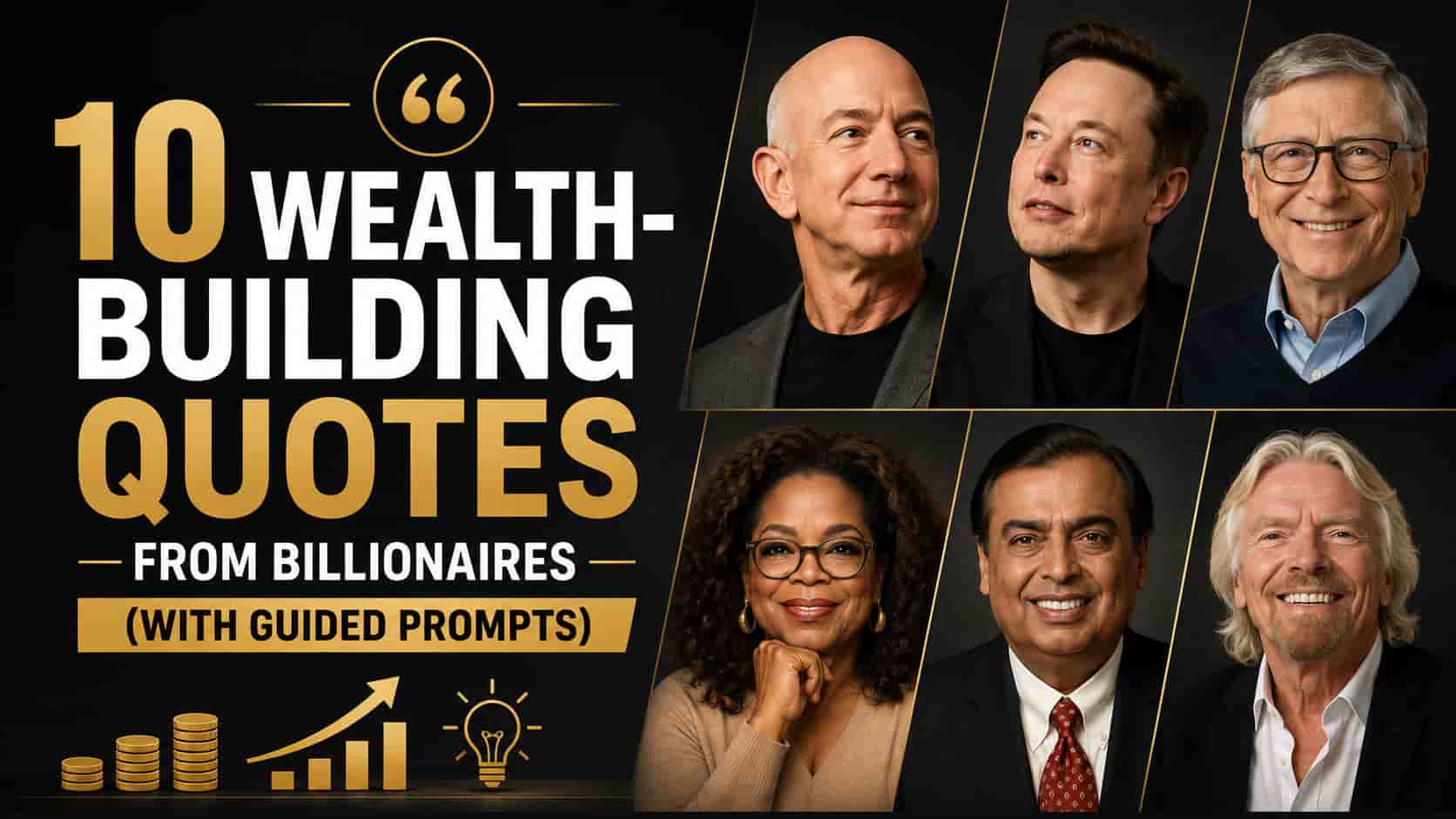
Billionaires get quoted constantly, and most of what circulates online is either fabricated or stripped of context until it means almost nothing. Below are ten billionaire quotes that are genuinely traceable to the people they’re credited to, drawn from a mix of tech, finance, retail, and global business. Each one comes with a short note on what it actually means and a guided prompt so the idea doesn’t just sit on the page. Work through the ones that make you pause. That pause is usually where the useful part starts.
In this article
1. Jeff Bezos
“If you don’t understand the details of your business, you are going to fail.”
Note: Bezos built Amazon on an obsession with operational detail, not just big-picture vision. This quote pushes back against the myth that successful founders only think in broad strokes. The people who build lasting wealth typically know their numbers, their margins, and their customers at a granular level.
Guided Prompt: Pick one financial account, business line, or investment you own. Can you explain, in specific numbers, exactly how it performed last month? If not, what’s the smallest step you could take today to close that gap?
2. Charlie Munger
“The first rule of compounding is to never interrupt it unnecessarily.” — as recounted in Morgan Housel’s The Psychology of Money
Note: Munger, Warren Buffett’s longtime business partner at Berkshire Hathaway, made this point about investing, but it applies to almost any form of wealth-building. Skills, relationships, and savings all compound the same way money does. The biggest threat to compounding usually isn’t a bad decision. It’s an unnecessary interruption, panic selling, quitting a skill halfway, or abandoning a habit right before it would have paid off.
Guided Prompt: Think of one long-term financial or personal habit you’ve interrupted in the past out of impatience or fear. What would it look like today if you’d left it alone?
3. Elon Musk
“I could either watch it happen, or be a part of it.”
Note: This line captures the difference between people who wait for opportunities to arrive fully formed and people who commit to something uncertain because they’d rather try and fail than spend years wondering. Musk has said this in the context of major technological shifts, but the underlying logic scales down easily to career changes, investments, or new ventures.
Guided Prompt: Name one opportunity or industry shift you’ve been watching from the sidelines. What’s one concrete way you could become a participant in it instead of an observer, even in a small way?
4. Oprah Winfrey
“I feel that luck is preparation meeting opportunity. If you hadn’t been prepared when the opportunity came along, you wouldn’t have been lucky.”
Note: A close variation of this idea is often misattributed to the Roman philosopher Seneca, whose actual writings never contain the exact phrase. Oprah’s specific wording, however, is well documented as her own, dating back to interviews from the early 1990s. Her point reframes luck entirely: it’s not something that happens to you, it’s something you become ready for.
Guided Prompt: Think of an opportunity you missed because you weren’t ready for it. What specific preparation, a skill, a saved amount of money, a certification, would put you in position the next time something similar comes along?
5. Bill Gates
“It’s fine to celebrate success, but it is more important to heed the lessons of failure.”
Note: Gates has spoken openly about early missteps at Microsoft, including underestimating the internet’s importance in the 1990s. This quote reflects a mindset common among people who build wealth over decades rather than overnight: failures get studied, not just survived.
Guided Prompt: Write down one financial or business mistake from the past two years. What is the single clearest lesson it taught you, and have you actually applied that lesson since?
6. Richard Branson
“A business has to be involving, it has to be fun, and it has to exercise your creative instincts.” — Losing My Virginity
Note: Branson has built companies across airlines, music, telecom, and space travel, and he’s been consistent about one thing: he says he never entered a business purely to make money. This isn’t a dismissal of profit. It’s an observation that ventures built purely around money tend to lose steam, while ventures built around genuine engagement tend to survive long enough to become profitable.
Guided Prompt: Look at your current income sources or business ideas. Which one genuinely interests you beyond the paycheck? Is that the one getting most of your energy right now?
7. Mark Cuban
“It doesn’t matter how many times you fail, you only have to be right once.”
Note: Cuban failed at several ventures, including a short-lived powdered milk business, before selling Broadcast.com to Yahoo for billions. His point isn’t that failure doesn’t matter. It’s that a track record of failed attempts becomes irrelevant the moment one attempt succeeds, provided you were still in the game to take that one shot.
Guided Prompt: List three attempts, business ideas, applications, or investments, that didn’t work out. What’s one more attempt you could make this month instead of treating those failures as a final verdict?
8. Ray Dalio
“Pain plus reflection equals progress.” — Principles: Life and Work
Note: Dalio built Bridgewater Associates into one of the largest hedge funds in the world, and this formula sits at the center of his personal philosophy. The keyword is “reflection.” Pain alone doesn’t teach anything. It’s the deliberate act of sitting with a financial loss or a bad decision and extracting a specific lesson that turns the pain into forward motion.
Guided Prompt: Think of your most painful financial decision. Have you ever actually written down, in plain language, what specifically went wrong and what you’d do differently? If not, take ten minutes and do it now.
9. Mukesh Ambani
“Any business that has the sole purpose of making money is not worth doing.”
Note: As chairman of Reliance Industries, one of the largest conglomerates in the world, Ambani has repeated a version of this idea across interviews: that business should serve a larger purpose beyond profit. This isn’t naive idealism from someone who hasn’t had to worry about money. It’s a pattern echoed by many long-term wealth builders across different countries and industries: that purpose tends to outlast motivation based on money alone.
Guided Prompt: If your primary income source disappeared tomorrow, what purpose beyond money would you still want it to serve? How closely does your current work reflect that?
10. Sara Blakely
“What did you fail at this week?” — the question her father asked at the dinner table throughout her childhood
Note: Blakely built Spanx from a $5,000 investment into a billion-dollar company, and she’s credited this specific childhood ritual as foundational to her risk tolerance. Her father wasn’t asking to shame her. He was disappointed when she had no failures to report, because that meant she hadn’t tried anything new. This flips failure from something to avoid into a weekly target.
Guided Prompt: Ask yourself Blakely’s father’s question right now: what did you fail at this week? If you don’t have an answer, what’s one small financial or business risk you could take before the week ends?
Why These Quotes Matter Right Now
What separates this list from generic motivational content is that every person quoted here built wealth through repeated cycles of risk, failure, reflection, and adjustment, not through a single lucky break. That pattern matters more today than ever, because financial content online increasingly promises shortcuts, guaranteed returns, or overnight success stories that skip the uncomfortable middle part entirely.
These ten quotes come from people who operated in completely different industries, countries, and decades, yet they converge on a small set of shared behaviors: understanding details deeply, treating failure as data rather than verdict, protecting long-term habits from short-term panic, and building things that hold personal meaning beyond the money itself. None of that requires billionaire-level capital to start practicing.
A Closing Note for Readers
You don’t need Bezos’s company or Dalio’s hedge fund to apply any of this. Pick the one quote and prompt from this list that made you the most uncomfortable to read, and give it fifteen honest minutes today. The quotes are memorable. The prompts are where the actual change happens.