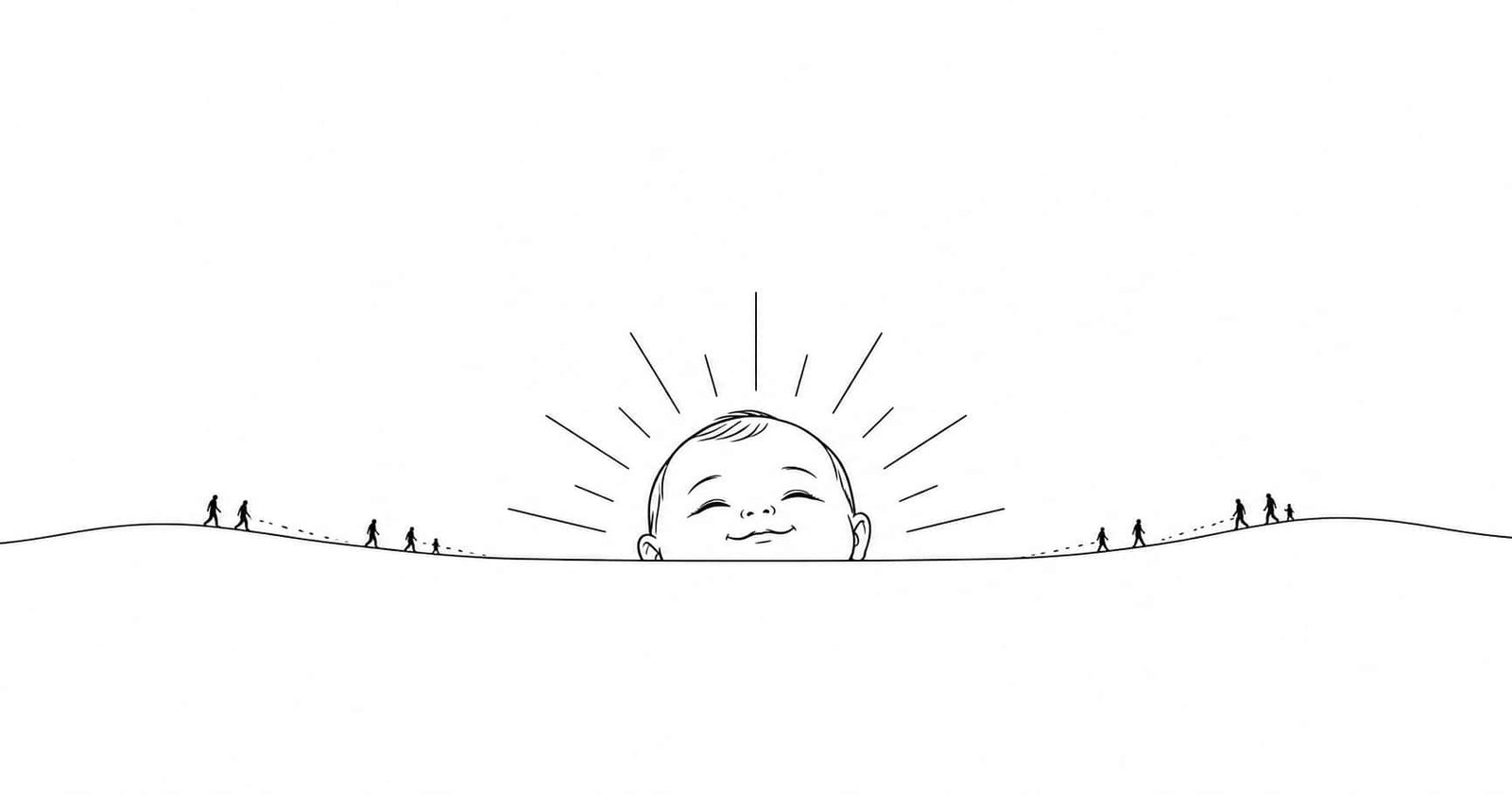
A reflection on a poem from my book The Philosophy of Loving the World
In this article
Think of the last time you saw a baby smile. For a moment, everything else felt lighter. A baby’s smile asks for nothing. It simply shows up and makes the day better.
Now think of the millions of babies whose smiles never get the chance to bloom. That thought is where my poem “Waiting on the Horizon” begins.
The Poem
Waiting on the Horizon
The smile of a baby is a beauty
that hides in our hearts,
like a dawn hiding on the horizon.But millions of babies are underprivileged.
Millions of smiles cannot bloom
because their cries are never heard.What will they do with your technology?
What will they do with your wealth,
while they go without clean air, water, and food
and live miles away from a classroom?Your borders divide but do not feed them.
Your markets trade but do not clothe them.
Your treaties bind but do not teach them.
Your summits speak but do not hear them.All of them are waiting on the horizon
for your mercy to reach them.
A Smile Is Like a Sunrise
I compared a baby’s smile to a dawn hiding on the horizon. Before the sun comes up, the sky is already getting ready. The light is there, but you cannot see it yet.
That is how I see every child. Inside each one there is joy, talent and a whole future, waiting for the right conditions to come out. A child who is fed, safe and in school will shine. A child who is hungry, sick and ignored will stay in the dark, not because the light is missing, but because nobody opened the door.
Cries That Are Never Heard
The second stanza says millions of smiles cannot bloom because the cries behind them are never heard.
Think about how a baby communicates. A baby cannot write a letter, vote, or protest. Crying is the only voice a baby has. In a healthy home, someone always answers. But in many places around the world, nobody does. Children go without enough food, clean water, safe air or a school they can reach. They cry, and the world carries on.
I do not say this to shock anyone. I say it because it is true, and because we are very good at looking away from things that make us uncomfortable.
“What Will They Do With Your Technology?”
The third stanza turns into a question, and it is the one I most want readers to think about.
We live in an age of amazing progress. We have phones that fit in a pocket, medicines that were once unimaginable, and machines that can do the work of hundreds of people. Science has given us the knowledge to purify water, grow more food and treat many diseases.
So why do millions of children still lack the basics?
The problem is not that we do not know how. The problem is that what we know is not reaching the people who need it most. A great invention is only great if it makes someone’s life better. Wealth and technology that stay behind a wall help the person inside the wall and nobody else. That is why I asked what a hungry child will do with our technology. To a child with no clean water, a faster phone means nothing.
Four Things We Build That Do Not Help
The fourth stanza is the one people tend to remember. It lists four pillars of the modern world, and says what each one does not do.
- Borders divide but do not feed. Lines on a map decide who belongs where. They have never filled a single empty plate.
- Markets trade but do not clothe. Trade creates enormous wealth, but wealth does not travel to the poorest by itself.
- Treaties bind but do not teach. Agreements are signed with great ceremony, and then a child still walks miles to find a school, or finds none.
- Summits speak but do not hear. Leaders gather and talk. But the people they are talking about are never in the room.
I am not saying borders, markets, treaties and summits are bad. Many of them do real good. I am saying that none of them is enough on its own. They only matter when they end in an actual meal, an actual coat, an actual classroom, an actual person who is listened to.
Where Science and Spirituality Agree
This poem sits in a category about science, spirituality, peace and integrity, and that is not an accident.
Science tells us the facts. A child without clean water or enough food does not grow as he or she should, in body or in mind. The damage can last a lifetime.
Spirituality tells us what to do about those facts. Almost every faith I have studied, including Christianity, Hinduism and Islam, teaches mercy and care for the helpless. Children are treated as precious in all of them.
When the facts and the faith point the same way, there is not much left to argue about. What remains is a choice: do we act, or not?
The Last Two Lines
The poem ends quietly: “All of them are waiting on the horizon for your mercy to reach them.”
Notice the word your. I did not write “the world’s mercy” or “the government’s mercy.” I wrote your. The poem speaks to the reader directly, because change does not begin with some distant authority. It begins with ordinary people who decide to care and then do something about it.
And notice the word waiting. These children are not giving up. They are waiting. That is a kind of hope, and a kind of trust. The question is whether we will deserve it.
What You Can Do
You do not need to be rich or powerful to help. Here are a few simple steps:
- Support a trusted charity. Choose one that provides food, clean water, health care or education for children, and give regularly, even if the amount is small.
- Use your voice. Talk about child poverty with your family, friends and community. Silence keeps problems hidden.
- Be mindful of waste. What we throw away, whether food or money or time, could mean a lot to someone else.
- Teach your own children to care. Let them see you give and help, so that kindness becomes normal for them.
The Deep Thought
Every sunrise starts with a thin line of light on the horizon. Whether that light grows into a full day depends on whether anyone is there to let it in. A child’s smile works the same way. It is already there. We just need to reach it.
If this poem moved you, please share this article with someone you care about. You can find more reflections like this in my book, The Philosophy of Loving the World.

Link to the Book
Available on Amazon: Amazon US | Amazon UK | Amazon CA | Amazon AU | Amazon IN and other Amazon marketplaces.
Other Philosophical Articles on This Book
- Peace Within, Peace Around Us
- Borders as Doorways: Loving Your Nation and the World
- The Shadow Self: Why Love Begins With What We Hide
- Why I Wrote The Philosophy of Loving the World
- The Earthitism Manifesto
- The Barest Means: A Poem on Poverty, Silence and the Sacred
FAQs
What is the poem “Waiting on the Horizon” about?
It is about the millions of children around the world who grow up without clean water, enough food or access to school. The poem asks wealthy and powerful people to see these children and to use their technology, money and influence to help them. It is from my book, The Philosophy of Loving the World.
Why does the poem compare a baby’s smile to a dawn?
A dawn is light that is almost here but not yet visible. In the same way, a baby’s joy and potential are already present, but they need the right conditions to show. The comparison reminds us that every child has a bright future inside, if we help it come out.
What does “Your borders divide but do not feed them” mean?
It means that political and economic systems, such as borders, markets, treaties and summits, are not enough on their own. They only help children when they lead to real action: food on the plate, clothes to wear and a chance to learn. The line asks us to measure our systems by what they actually do for the most vulnerable.