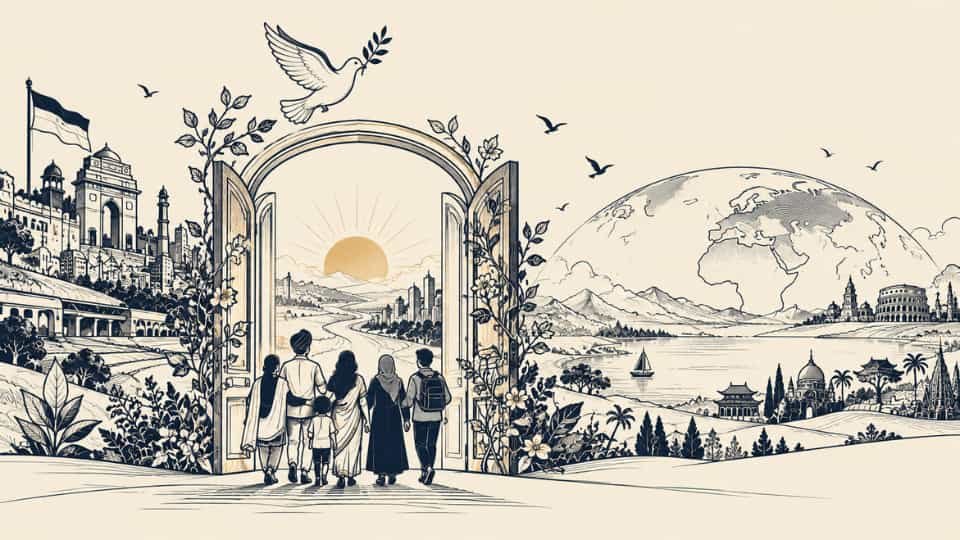
Love for the nation is one of the strongest feelings a person can have. It can also become one of the narrowest. So, that kind of love can begin with the philosophical concept of borders as doorways.
The same feeling that makes someone work for their village, defend their language, or weep at their anthem can, in another heart, harden into suspicion of everyone outside. In the fourth chapter of my book The Philosophy of Loving the World, titled “Love for the Nation,” I tried to hold both truths at once.
In this article
My answer begins with a short image. A nation is the heart of its people, with borders. The real question is what those borders are for.
When love of country fades
I opened the chapter with a claim that may seem surprising: love for the motherland fades where its people do not live in abundance and joy, at peace with one another.
Patriotism cannot be ordered into existence. It grows where people have enough, are treated fairly, and trust those who lead them. Where those things are missing, flags and slogans cannot replace them. A country that wants love from its people has to deserve it.
Several poems in the chapter speak to this. “The Distance Between” imagines leaders who truly feel the distance between their own comforts and the lives of the illiterate, the graduate, and the undergraduate alike. If they felt it, I wrote, there would be no need for protest, because people would already have their rights, their opportunities, and their liberty. “The Father of Mercenary Behavior” points to poverty and insolvency as the root of hearts that can be bought, and says a nation’s truest triumph is to build a foundation strong enough for education.
A cry that belongs to every child
One of the shortest poems in the chapter is about hope. The fear of poverty at the heart of the underprivileged will be uprooted by a rising cry: “I can be privileged.” I wrote that this truth should be enshrined in the tender soul of every child of the nation.
I believe a country measures itself by whether such a child can say those words and mean them.
Where division begins
If poverty and unfairness weaken love for a nation, what makes nations fight each other? I wrote about that in “Not with Weapons.” Today’s carnage, I suggested, begins not with weapons or militants, not with nuclear fire, not even with greed for power and wealth. It begins with the stories planted in biased minds burning with rage, and in hardened hearts that carry a stronger nation’s wounded pride when a weaker one refuses its unfair terms.
Another poem, “The Inner Battlefield,” goes further. The first whisper of corruption is born in the mind, not in the nation. The human heart is pure and honest, but when the mind’s poisoned blood reaches it, purity and honesty die. So the battlefield must first be the heart and mind. Teach the hearts, make the minds wise, and let them build the nation wholeheartedly. Then see the dawn of a world free of corruption.
That is why I do not think peace between nations can be built only by treaties. It has to be built first in how individual people think.
The mind and the heart
“Mind and Heart” is the poem I return to most when I think about this chapter. If the mind is the sword, the heart is the scabbard. If the mind is the law, the heart is the mercy. If the mind can hate, the heart can love. If the mind is for knowledge, the heart is for wisdom.
Then comes the line that turns the poem into an argument for nations: a nation needs both. A country run only by the mind becomes cold and cruel. A country run only by the heart may lack the discipline to protect itself. Healthy love of country keeps both.
The borders as doorways
The chapter’s central image is in the second half of its opening statement. Let the borders be a doorway, and let the garland of love and joy, abundance and peace be offered to the world.
I chose the word “doorway” carefully. A wall keeps people out. A doorway lets a household decide who comes in, who goes out, and what is exchanged. It protects without shutting the world away. I do not argue that borders should vanish. I believe they should be places of welcome, as well as places of safety.
The poem “The Garland” says the same thing in a different way. Let your country wear a garland of the world’s flowers, its own among them, in pride and joy. Let it be celebrated, let it stay vigilant, and let it stand valiant before the world.
I like that picture because it does not ask a nation to shrink. It asks a nation to be proud and generous at the same time.
A small planet
The chapter includes a short poem about my own country, “India, on This Tiny Planet.” It begins with a list of what India has given the world: yoga, devotion, mantra, epics, and gurus. It ends on a single line: on this tiny planet.
I included it because love for one’s homeland and awareness of the whole Earth belong together. India’s gifts are real, but they sit on one small planet that everyone shares. The same is true of every country’s gifts.
What this asks of us
I would suggest three small questions for anyone who loves their country.
- Does my love include the people who are poorest in my nation? A country is not only its monuments and its leaders.
- Do I know the stories I am telling about other nations? If those stories are built from pride and fear, they need to be examined.
- Would I be glad for my country to be loved by others? In the chapter’s first poem, the greatest human endeavor is to let a country love others and be loved by others in return.
Love for the nation, at its best, is not a smaller love that competes with love for the world. It is the place where that larger love first learns to speak.
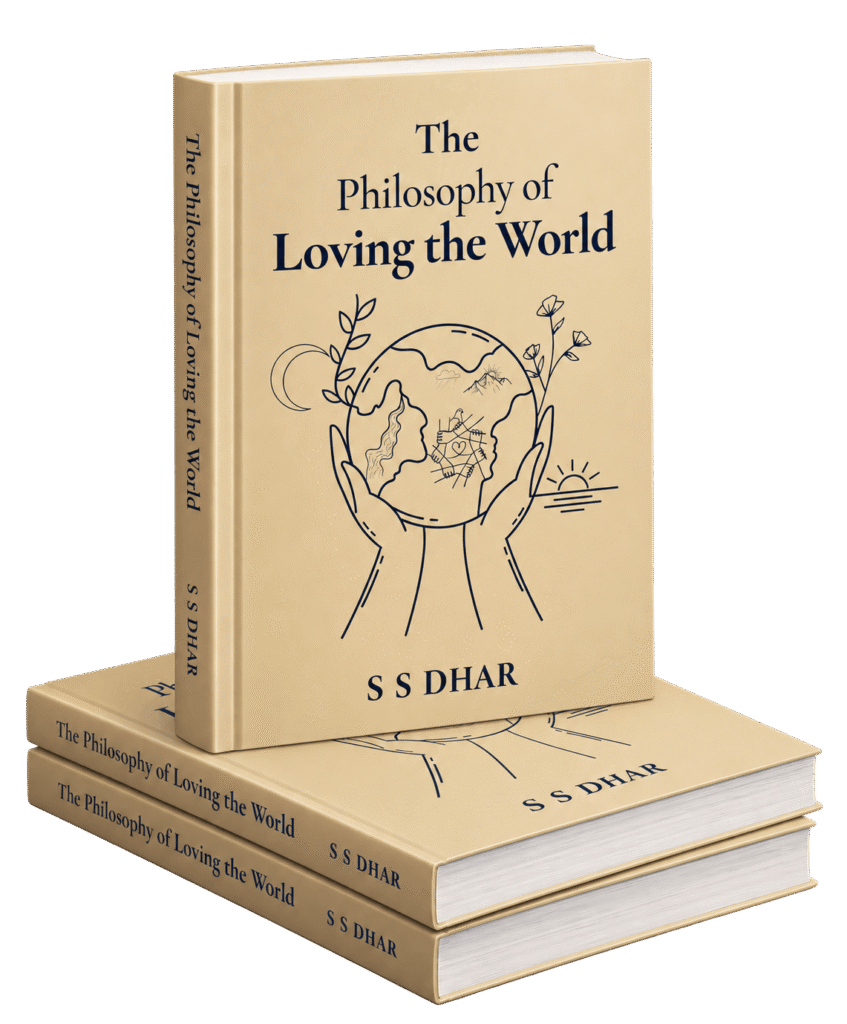
If you belong to that group of people who love the world, the book is available on Amazon.
The interesting fact is that, in this book, two newly coined terms are used with specific philosophical meaning in this book. Read the manifesto of the coined terms here: The Earthitism Manifesto
Read the reason for writing this book: Why I Wrote The Philosophy of Loving the World