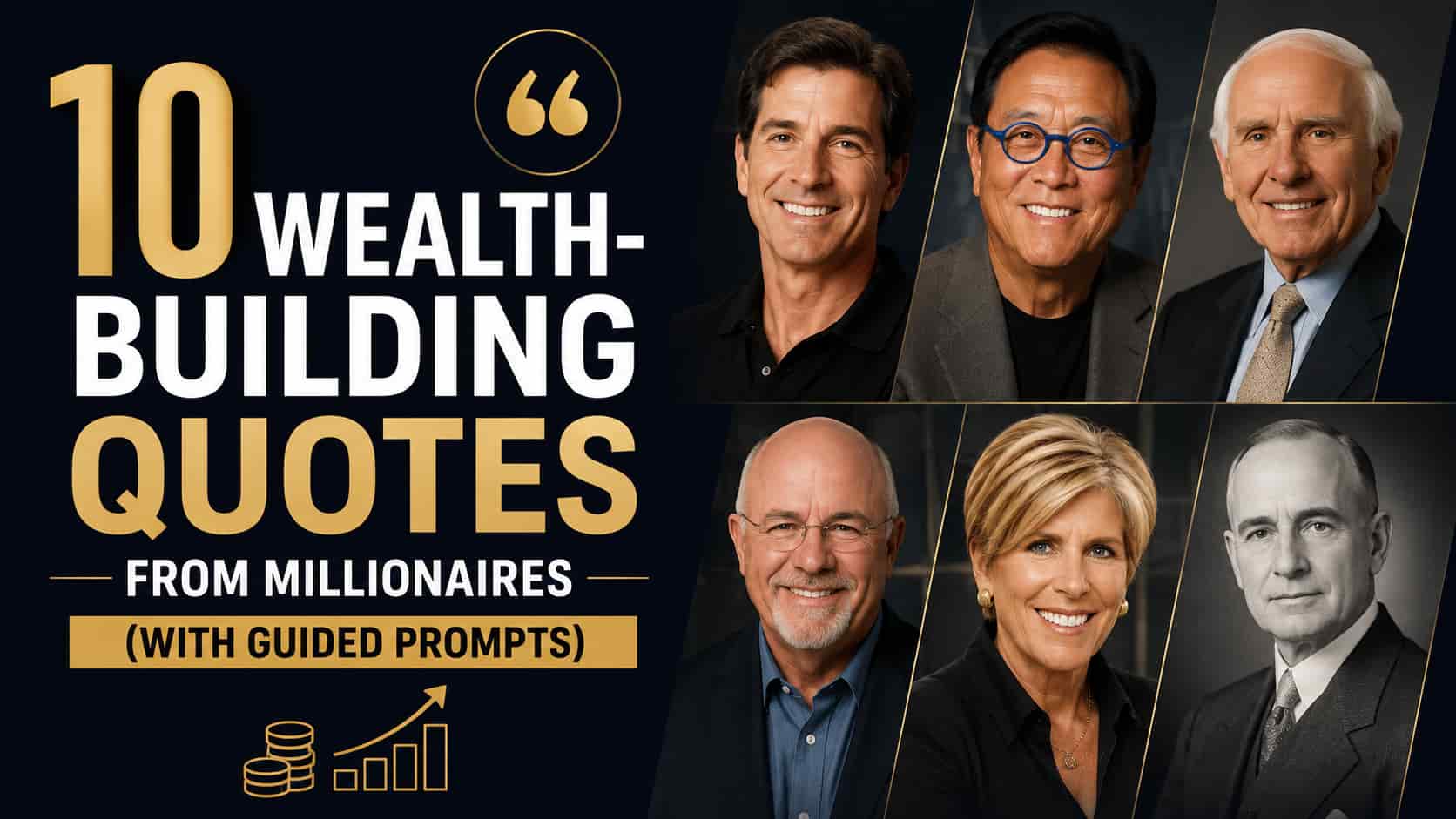
Most people read a wealth quote, nod, and move on within five seconds. That’s the problem. A good quote isn’t meant to be consumed like a snack. It’s meant to be applied. Below are ten verified millionaire quotes from self-made millionaires, each with a short explanation of why it matters and a guided prompt you can actually sit down and answer today. Skip the ones that don’t resonate. Work through the ones that sting a little, because those are usually the ones pointing at something you already know but haven’t acted on.
In this article
1. T. Harv Eker
“Rich people believe ‘I create my life.’ Poor people believe ‘Life happens to me.'” — Secrets of the Millionaire Mind
Note: This is the foundational belief that separates people who build wealth from people who wait for wealth to arrive. It’s not about blind optimism. It’s about where you point your attention when something goes wrong: at your next decision, or at your circumstances.
Guided Prompt: Think of one financial setback from the past year. Write down two things you could have controlled in that situation, even if the setback itself wasn’t your fault.
2. Robert Kiyosaki
“Most people fail to realize that in life, it’s not how much money you make, it’s how much money you keep.” — Rich Dad Poor Dad
Note: Income and wealth are not the same thing. Plenty of high earners stay financially fragile because their spending rises in step with their paycheck. Kiyosaki’s point is that the gap between what you earn and what you keep is where real wealth gets built.
Guided Prompt: Calculate roughly what percentage of your last three months’ income you actually kept, whether as savings or investment. Is that number higher or lower than you expected?
3. Jim Rohn
“Formal education will make you a living; self-education will make you a fortune.”
Note: Rohn lived this quote before he wrote it. He became a millionaire by 30, lost nearly all of it by 33, and rebuilt through relentless self-study. His point isn’t that school is worthless. It’s that the learning that compounds your income over decades rarely happens in a classroom.
Guided Prompt: What is one skill, directly tied to your income or investments, that you’ve been meaning to study but haven’t started? Block 20 minutes for it this week.
4. Dave Ramsey
“You must gain control over your money or the lack of it will forever control you.” — Financial Peace Revisited
Note: This quote from Ramsey captures a truth many people avoid facing: not managing money is still a decision, and it has consequences that compound the same way good decisions do, just in the opposite direction.
Guided Prompt: Write down one financial task you’ve been avoiding, whether it’s checking a balance, opening a statement, or starting a budget. Do it today, before you close this tab.
5. Suze Orman
“If you expect your money to take care of you, you must take care of your money.”
Note: Orman built her career on a simple but often ignored idea: money responds to attention. People who check their accounts, track their spending, and understand their investments tend to make better decisions than people who avoid looking.
Guided Prompt: When did you last review your full financial picture, including debts, savings, and investments, in one sitting? Schedule that review for this week if it’s been longer than a month.
6. Napoleon Hill
“Whatever the mind can conceive and believe, it can achieve.” — Think and Grow Rich
Note: This line gets dismissed as poster wisdom, but Hill never meant belief alone produces results. In his own writing, belief was the starting point that determines what a person is even willing to attempt, plan for, and persist through. Without it, ambitious goals get mentally downgraded before they’re ever tested.
Guided Prompt: Write down one financial goal you’ve quietly decided is “unrealistic” for you. What would change if you spent one week treating it as achievable instead?
7. Benjamin Franklin
“An investment in knowledge pays the best interest.”
Note: A quick honesty check: this quote is widely attributed to Franklin across quote collections, but its appearance in his verified writings is harder to pin down, a common issue with many old, frequently repeated sayings. That said, the idea fits Franklin’s documented life closely. He was famously self-taught, founded a subscription library, and treated learning as a lifelong investment strategy.
Guided Prompt: What’s one book, course, or skill you could invest in this month that would likely pay off financially within the next two years?
8. Andrew Carnegie
“Concentrate your energies, your thoughts and your capital.” — Address to students at Curry Commercial College, Pittsburgh, 1885
Note: Carnegie built his fortune by rejecting the instinct to diversify too early. His advice was to master one line of work deeply before spreading resources thin. For most people starting out, focus beats diversification, at least until there’s real expertise and capital to diversify with.
Guided Prompt: List every financial or business goal you’re currently juggling. Circle the one that would matter most if it were the only one you achieved this year.
9. John D. Rockefeller
“I would rather earn 1% off a 100 people’s efforts than 100% of my own efforts.”
Note: This is the essence of building systems, teams, or investments rather than trading hours directly for money. Rockefeller’s fortune came from owning infrastructure, not from working harder than everyone else. The same logic scales down to something as simple as investing in an index fund rather than only relying on active income.
Guided Prompt: Identify one part of your income that currently depends entirely on your direct time and effort. What’s one small step toward making a portion of your income less dependent on your hours?
10. Barbara Corcoran
“All the best things that happened to me happened after I was rejected. I knew the power of getting past no.”
Note: Corcoran built a real estate empire from a $1,000 loan and sold it for $66 million. Her advice reflects something wealth-builders across industries eventually learn: rejection is data, not a verdict. The people who keep going past “no” are usually the ones still standing when opportunity finally shows up.
Guided Prompt: Think of one “no” you received recently, whether in business, a job application, or an investment pitch. What’s the very next action you could take despite it?
Why These Quotes Matter Right Now
None of these ten people got wealthy through a single insight. Their quotes are compressed versions of years, sometimes decades, of decisions made the same way over and over. That repetition is exactly why these ideas still hold up. Financial technology has changed enormously since Rockefeller or Carnegie’s time, but the underlying behaviors- ownership of outcomes, discipline with spending, continuous learning, and resilience after failure- haven’t changed at all.
In a period where financial information is more available than ever, and yet financial stress remains widespread, these quotes work as a filter. They cut through the noise of trending stock tips and get-rich-quick content by pointing back to fundamentals that have worked across a full century of different economies.
A Closing Note for Readers
Don’t try to apply all ten prompts today. Pick one, the one that made you slightly uncomfortable when you read it, and actually do it. Wealth-building quotes are only useful the moment they turn into action. Read them, sit with the one that hits hardest, and let that discomfort do its job.