
Millionaires’ minds are the same as ours and work on the same ground from birth. But their mindsets, attitudes, thinking in different ways, surroundings, and family cultures make them different from us. This is called conditioning. Millionaires’ mind conditioning makes them earn in millions, mediocrities’ mind conditioning makes them earn in thousands, and poor mind conditioning makes them earn in hundreds.
In this article
The uncomfortable truth is that most of us never stop to examine the conditioning running inside our heads. We grow up hearing statements about money from parents, relatives, teachers, neighbors, and society. Over time, those statements quietly become our beliefs. We may think we are making our own financial decisions, but in reality, many of our choices are driven by programming we accepted years ago without questioning it.
We are shocked when we become aware of our old conditioning that is rented on our subconscious mind.
The Four-Step Money Blueprint
Every meaningful change starts with awareness. If I don’t know a problem exists, how can I fix it? The same applies to money.
The blueprint begins with four powerful steps:
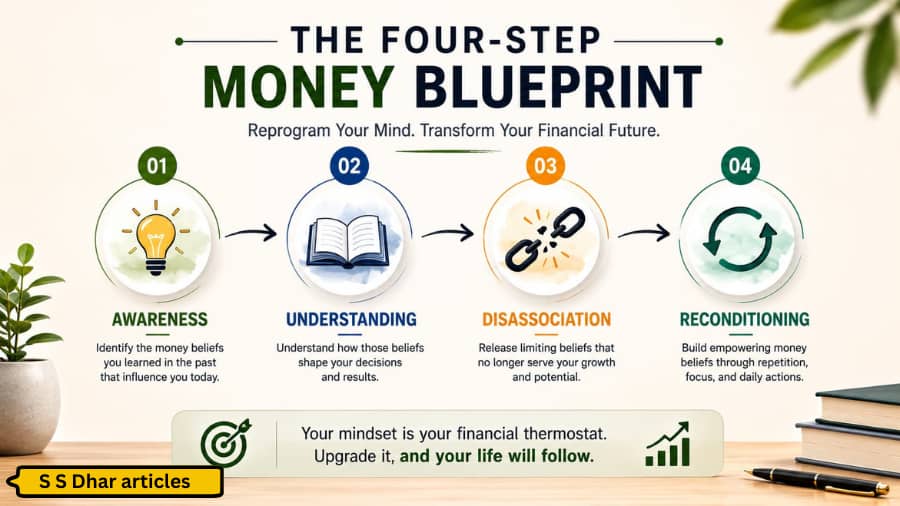
1. Awareness
Think back to your childhood. What did you hear about money?
Maybe you heard that rich people are greedy. Maybe you were told money is hard to earn. Maybe someone repeatedly said that people like us can never become wealthy.
Write those statements down.
Most of us have never consciously reviewed the beliefs that shaped our financial lives. Yet they influence our decisions every day.
2. Understanding
Once we identify those beliefs, we need to understand their impact.
Did they make us afraid of taking risks?
Did they make us settle for less?
Did they make us feel guilty about wanting more money?
When we connect our present financial situation with past conditioning, we start seeing patterns that were previously invisible.
3. Disassociation
This is where things become interesting.
Just because I learned something doesn’t mean it is true. Just because a belief entered my mind doesn’t mean it belongs there forever.
Many money beliefs are simply pieces of information stored years ago. They are not my identity. They are not your identity.
Once we realize this, we can separate ourselves from limiting beliefs and choose a different path.
4. Reconditioning
After awareness, understanding, and disassociation comes reconditioning.
New beliefs need repetition. New thinking needs reinforcement.
If old conditioning created our current results, new conditioning can help create new results.
The goal is not to pretend to be wealthy. The goal is to train ourselves to think, act, and make decisions differently.
Your Financial Thermostat
One idea that caught my attention is that income often grows only to the level that our internal blueprint allows.
Many people focus entirely on external tools—better jobs, business strategies, marketing techniques, or investment opportunities. These things matter. But if our internal blueprint remains unchanged, we often sabotage our own progress.
It’s similar to having a large bucket and a small bucket.
Even if money flows in, a small financial container can only hold so much before it leaks away through poor decisions, fear, self-doubt, or lack of confidence.
Before asking how to make more money, it may be worth asking:
What level of success does my mind currently believe I deserve?
Are You Playing to Win or Playing Not to Lose?
This question separates two completely different mindsets.
Many people approach money defensively. Their main objective is survival.
They want enough to pay bills.
Enough to avoid problems.
Enough to stay safe.
There is nothing wrong with wanting security. The problem is that security becomes the finish line.
People who build significant wealth often operate from a different intention. Their focus is expansion, growth, and abundance rather than mere survival.
The difference is subtle but powerful.
One mindset asks:
“How do I avoid losing?”
The other asks:
“How do I create more?”
The answer to those questions leads to very different actions over time.
The Comfort Trap
One of the most striking ideas in this blueprint is the difference between being comfortable and being rich.
Most people openly say they want to be comfortable.
Comfortable sounds reasonable.
Comfortable sounds safe.
Comfortable sounds responsible.
But comfort can quietly become a limitation.
When comfort becomes the goal, we stop stretching ourselves. We stop aiming higher. We stop imagining larger possibilities.
I want to tell you something that people often achieve exactly what they truly intend to achieve.
If my goal is simply comfort, I may eventually reach comfort.
But if my goal is wealth, growth, and financial freedom, comfort often becomes a by-product along the way.
The lesson isn’t about greed.
It’s about being honest regarding what we actually want.
The Restaurant Test
There is a simple example that perfectly illustrates this mindset.
Some people choose meals by first looking at the prices. The decision begins with cost.
Others decide what they truly want and then look at the price later.
The example isn’t really about food.
It’s about psychology.
One mindset is driven by limitation.
The other is driven by preference and possibility.
Of course, being financially responsible matters. Nobody should spend recklessly.
But the example highlights how deeply our money conditioning influences everyday decisions.
Observe Yourself Like a Scientist
Another powerful lesson is the role of consciousness.
Most of us move through life on autopilot.
We repeat habits.
We repeat thoughts.
We repeat emotional reactions.
And we rarely question them.
I want you to be encouraged enough to observe yourself closely.
Watch your thoughts about money.
Watch your reactions when someone becomes successful.
Watch how you feel when discussing wealth, investing, business, or income.
Those reactions reveal the hidden programming beneath the surface.
Awareness creates choice.
Without awareness, we simply repeat the past.
The Mid-20s Advantage
If you’re in your mid-20s, you have something incredibly valuable: time.
Many people don’t begin examining their money blueprint until their 40s, 50s, or even later.
You don’t need to wait that long.
You can start identifying limiting beliefs today.
You can challenge old assumptions today.
You can consciously build new habits today.
The earlier you begin, the more years your new conditioning has to compound.
Just as money compounds, beliefs compound too.
A stronger mindset today can influence thousands of decisions over the next decade.
And those decisions can completely change your financial future.
If you are in your 20s, you are likely to be interested in the following articles:
Why Rich People Use 5 Bank Accounts to Manage Their Money Differently
Manifestation of Money is a Scam Without Doing These
Three Wealth Principles That Changed My Life Within 2 Years
What to Follow Finally:
The millionaire’s blueprint isn’t a secret investment formula or a shortcut to instant wealth. It begins with something much deeper: the beliefs we carry about money.
When we become aware of those beliefs, understand where they came from, separate ourselves from limiting ideas, and consciously recondition our thinking, we start operating from a different level.
The biggest shift may not happen in your bank account first.
It may happen in your mind.
And once the mind changes, everything else gets a chance to be changed. Start identifying your money blueprint from today and start reconditioning it from day one. After a year, you’ll see significant changes in your blueprint and results.