I still remember the night I sat at my kitchen table with four different bills spread out in front of me, a calculator in one hand and a sinking feeling in my chest. I wasn’t drowning in debt, but I wasn’t free either, and that in-between space is its own kind of stressful. I kept asking myself the same question so many people ask at some point in their financial life: which debt do I pay off first?
In this article
That question eventually led me down a rabbit hole of two competing strategies that show up in almost every personal finance conversation: the debt snowball and the debt avalanche. Both promise to get you out of debt. Both have loyal followers. And both, it turns out, are right, just in different ways. If you’re staring at your own stack of bills right now, here’s everything I wish someone had explained to me before I picked a side.
What Is the Debt Snowball Method?
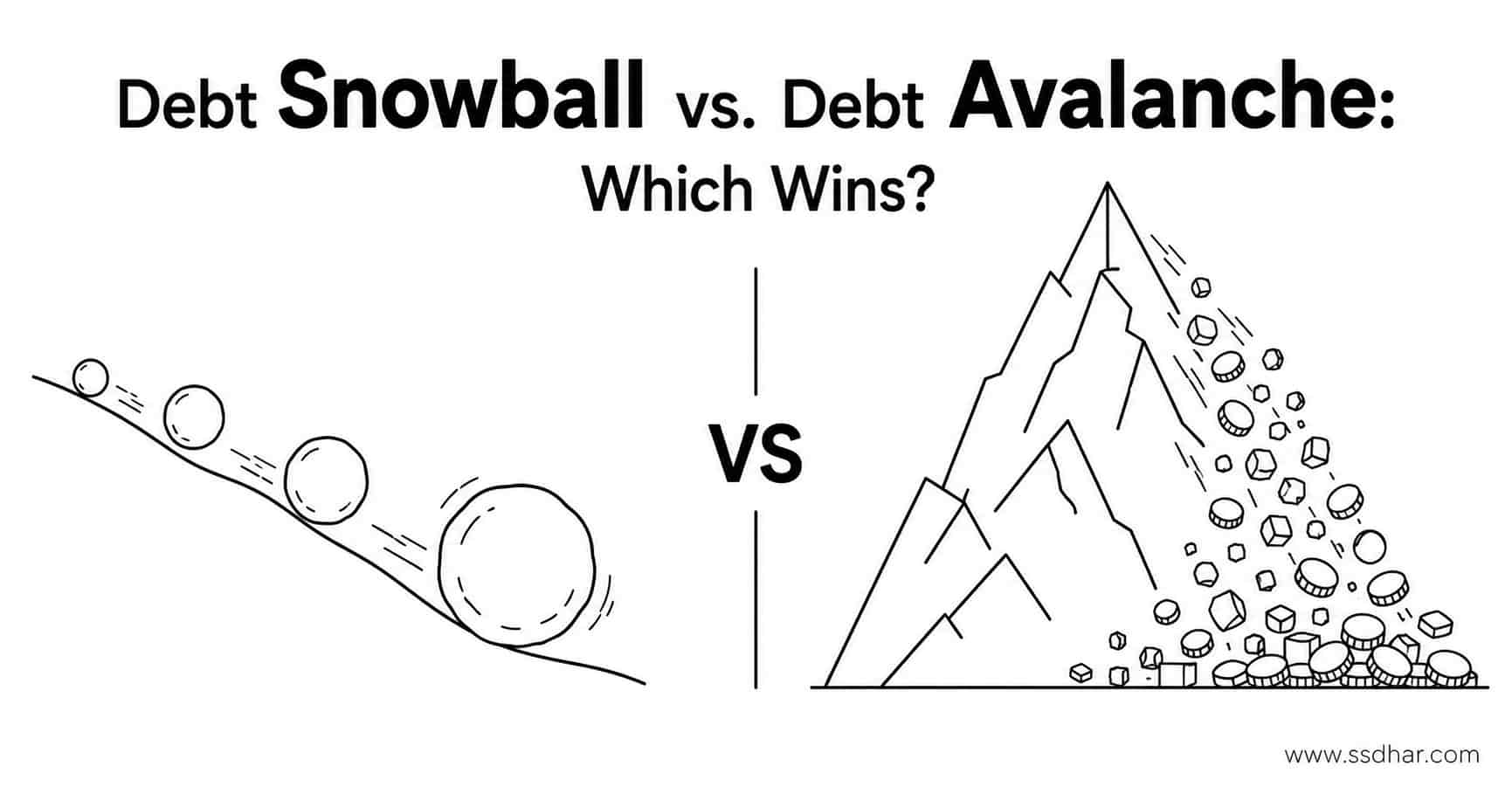
The debt snowball method is simple, and that simplicity is exactly the point. You list every debt you owe from smallest balance to largest, completely ignoring the interest rate. You make minimum payments on everything except the smallest debt, and you throw every extra dollar you can find at that one account. Once it’s paid off, you take the money you were putting toward it and roll it into the next smallest balance, then the next, and so on. The payments “snowball” as you go, getting bigger and faster with every debt you clear.
This is the method made famous by financial author and radio host Dave Ramsey, and its biggest selling point is momentum. You get a win early, sometimes within a month or two, and that win keeps you motivated to keep going.
What Is the Debt Avalanche Method?
The debt avalanche method flips the order. Instead of organizing by balance, you organize by interest rate. You list your debts from highest interest rate to lowest, make minimum payments everywhere else, and put every spare dollar toward the debt charging you the most interest. Once that’s gone, you move to the next highest rate.
The avalanche method is the mathematically “correct” choice. Because you’re attacking the most expensive debt first, you pay less in total interest over the life of your repayment plan, and in most cases you’ll be debt-free a little sooner too, even if it doesn’t feel that way in the first few months.
Debt Snowball vs. Debt Avalanche: Quick Comparison
Here’s how the two methods stack up side by side.
| Factor | Debt Snowball | Debt Avalanche |
|---|---|---|
| Order of payoff | Smallest balance first | Highest interest rate first |
| Best for | Motivation and momentum | Saving the most money |
| First win | Usually fast | Can take longer |
| Total interest paid | Slightly higher | Lowest possible |
| Math-optimal? | No | Yes |
| Psychology-optimal? | Yes, for most people | Depends on discipline |
Neither column is “wrong.” They’re built for two different problems, money math and money behavior, and most of us are dealing with both.
The Math Behind the Avalanche Method
Let’s make this real with a simple example. Say you have three balances: a store card at $1,000 with a 28% interest rate, a personal loan at $4,000 with a 12% rate, and a major credit card at $2,500 with a 22% rate. With the avalanche method, you’d attack the store card first since it has the highest rate, not because it’s the smallest. Mathematically, this saves you money because high-interest debt grows the fastest when it’s left alone.
According to recent Federal Reserve data, the average American household now carries more than $11,500 in credit card debt, and the average interest rate on cards that carry a balance sits above 21%. At that kind of rate, interest alone can quietly add hundreds of dollars to your balance every year if you’re only making minimum payments. The debt avalanche method exists specifically to shrink that bleeding as fast as possible.
If your goal is purely financial efficiency, the avalanche method wins, full stop. The catch is that “purely financial” rarely describes how real people actually behave.
The Psychology Behind the Snowball Method
This is where things get interesting, because the debt snowball method isn’t just a feel-good shortcut. It’s backed by real research.
In 2012, two professors at Northwestern University’s Kellogg School of Business, David Gal and Blakeley McShane, studied data from roughly 6,000 people working with a debt settlement company. Their findings, published in the Journal of Marketing Research, showed that people who paid off their smallest debts first were significantly more likely to eliminate their entire debt load compared to those using a strictly interest-rate-based approach. The math wasn’t on their side, but the motivation was, and motivation turned out to matter more.
“Tell your money where to go instead of wondering where it went.” — Dave Ramsey
That quote captures exactly why the snowball method works for so many people. Personal finance isn’t only a math problem; it’s a behavior problem. Closing out an account, even a small one, creates a sense of progress that a spreadsheet can’t replicate. You feel like you’re winning, so you keep playing.
What I Learned the Hard Way About Debt and Discipline
I’ll be honest with you: when I first started paying down debt, I tried to do everything “correctly.” I built spreadsheets, calculated interest down to the decimal, and convinced myself that the smartest plan was the one with the lowest total cost on paper. What I didn’t account for was my own willpower running out somewhere around month three.
What actually kept me consistent wasn’t the perfect formula. It was closing one account and feeling, for the first time in a while, like the debt was shrinking instead of just sitting there. That small psychological shift changed how I treated every dollar after that. I became more careful with spending, more intentional with saving, and far less likely to add new debt on top of what I already had. Discipline, I learned, builds on itself the same way debt does, just in the opposite direction.
That experience is honestly a big part of why I write about money management at all. The numbers matter, but the habits and mindset behind the numbers matter just as much, sometimes more.
Which Method Fits Your Personality?
Before you choose between the debt snowball and the debt avalanche, it helps to be honest about how you actually behave with money, not how you wish you behaved.
- If you’ve started and abandoned budgets before, you likely need quick wins. Choose the snowball method.
- If you’re naturally patient and motivated by long-term savings, the avalanche method will serve you well.
- If one debt carries a dramatically higher interest rate than the rest, lean avalanche, the savings are too significant to ignore.
- If you have many small debts cluttering your financial life, lean snowball, clearing accounts simplifies everything.
- If you’re not sure, start with whichever method gets you to make your first extra payment this week. Progress beats perfection.
This isn’t only an American conversation either. Whether you’re tackling a credit card balance in the US, a personal loan in the UK, a line of credit in Canada, a buy-now-pay-later balance in Australia, or multiple small loans in India, the same two strategies apply. The currency changes, the psychology doesn’t.
The Hybrid Approach: Best of Both Worlds
You don’t actually have to pick a side forever. A lot of people, myself included, end up using a hybrid version. Start with the debt snowball method to get an early win and build momentum, then once you’ve cleared a couple of small balances and built some confidence, switch your extra payments toward the highest interest rate debt remaining.
This hybrid approach lets you borrow the best part of each strategy: the early motivation of the snowball and the long-term savings of the avalanche. There’s no rule that says your debt payoff plan has to be rigid. The only rule that actually matters is that you keep paying more than the minimum, consistently, until the balance hits zero.
If you’re interested, look at the articles also:
Opinionated Summary
The debt snowball vs. debt avalanche debate often gets framed as a battle between emotion and logic, but I think that framing misses the point. Getting out of debt is a long game, and any strategy you’ll actually stick with beats a “perfect” plan you abandon by spring. Pick the method that matches your personality, track your progress somewhere visible, and remember that every payment, big or small, is moving you toward a version of your life with one less bill hanging over it.
Frequently Asked Questions
Which is better, debt snowball or debt avalanche?
Neither method is universally better. The debt avalanche method saves more money in interest, while the debt snowball method tends to keep people more consistent because of early wins. The best method is the one you’ll actually follow through on.
How much money can the debt avalanche method actually save me?
It depends on your balances and interest rates, but the gap can range from a small amount to several hundred or even a few thousand dollars over the full repayment period, especially if one of your debts carries a much higher rate than the others.
Can I switch between the debt snowball and debt avalanche methods?
Yes. Many people start with the snowball method for motivation, then shift to the avalanche method once they’ve built momentum and paid off a few smaller balances.
Do I need to stop using credit cards while paying off debt?
It’s not strictly required, but most people find it far easier to make real progress when they pause new credit card spending while focused on payoff. Otherwise, you risk adding new debt as fast as you clear old debt.
Does the debt snowball or avalanche method work for student loans too?
Both strategies can apply to student loans, especially if you have multiple loans with different balances and interest rates. The same logic, smallest balance first versus highest rate first, carries over directly.
If this gave you a clearer picture of how to finally tackle your balances, consider subscribing to my newsletter for more money management guides like this one, sent straight to your inbox.
And if you want a deeper look at why we spend and borrow the way we do in the first place, my book, The Psychology of Spending: Master Your Money Habits and Avoid Financial Traps, walks through the psychology behind everyday money decisions, including the ones that lead to debt in the first place.