
Becoming financially free is one of the key concerns among young adults worldwide. Every college student, every adult, wants to become financially free in their 20s without considering their basic financial background, key skills for active earning, demanding education for high-paying jobs, proper financial knowledge to multiply earnings by increasing the number of sources of active income, and, finally, the right attitude and mindset. That is where the frustration comes in, and they are stuck when they don’t understand how to prioritize the crucial factors. These are not inborn factors, but rather acquired through conditioning and circumstances.
In this article
So, after studying multiple books, and on the basis of my understanding and experience, I found these 5 principles that actually work for any individual who wants to become financially free in their late 20s.
One crucial note: Following the principles for a month or a year may not bring freedom without having huge capital at the beginning, without a strategic investment plan and activity. You must realize that it’s a process of at least 3-5 years; it’s a living principle before going through financial freedom, but it’s not an overnight process.
All the principles may not work for high-net-worth individuals and may depend on their current condition and state of financial stability.
So, let’s begin with the first principle.
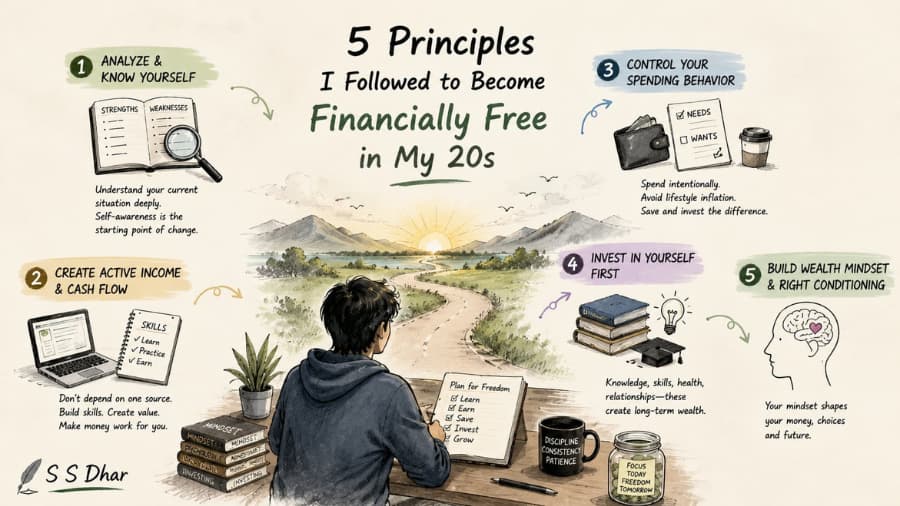
First Principle: Analysing Key Conditions and Understanding the Basic Factors
Understanding the factors mentioned in the beginning that create frustration and make you stuck in the boredom of earning money and a financial freedom mindset for becoming financially free before your 30s. It’s the first step towards that goal. You may take 2-3 days to analyze and understand each and every factor and make a clear note of each factor with a proper declaration for each factor.
This practice of analysis will tremendously help you sort out your current conditions of earning, spending, saving, investing, and wasting money on unwanted stuff. This will also help you find key areas of your potential strengths and weaknesses. By analyzing the factors, you can also discover the ways to strengthen your weaknesses if required towards financial freedom, and let you synchronize the strengths and modified weaknesses. Skipping the first principle and jumping to the next principles will always create doubt and frustration. So all the principles are essential and must be followed in order.
Now, let’s go to the second principle.
Second Principle: Focus on Active Income and Initial Cashflow
The second step towards financial freedom is focusing on active income. For those who don’t have basic financial stability to follow other steps, active income is the only source of cash flow. Without initial cash flow, no individual can survive for basic needs (that’s food, shelter, and essential expenses as described by Maslow’s Hierarchy of Needs). Without working actively, those who can manage the money for basic needs still need some extra money to follow other principles, because without having some extra money, you can barely follow.
And for those who can’t manage even $100 a month without working actively, the first step is to find work to do actively, which will let them go towards financial freedom a bit by bit.
So, in my experience, without working actively, which will bring cash flow for your current needs, working to generate a passive income for financial freedom may bring frustration if the method or strategy is not fruitful in 2-3 attempts. This will loop you into the cycle.
Generating passive income without initial investment of money and proper skill, and purely based on investing significant time, effort, and a moderate level of knowledge and skill, is not as easy as you hear about generating passive income or a side hustle in business articles, magazines, tutorials, or other ways. Your strategies may fail multiple times, efforts and significant time may be wasted, willpower and motivation may be broken down, and finally, you become unstable and fail in life.
So, the active work will bring that much cash flow for your basic needs, along with some extra expenses, and that will bring the peace of mind that will make you feel like, “Okay. Now, I’m capable of thinking of some other ways to multiply my earnings.” That attitude will lead you towards financial freedom step by step.
So, initially, some active work is as essential as the basic needs explained by Maslow in his Hierarchy of Needs psychological theory.
Let’s step up to the next principle towards financial freedom.
Third Principle: Changing the Pattern of Spending Behaviour
Saving $1 every day from spending on unwanted stuff will accumulate you $30 a month, and that much money can buy you a course for developing a new skill, which eventually will help you create so much money directly or indirectly.
Any individual from the ground level of financial circumstances must be frugal to become financially free. As the wise quote by Warren Buffett:
“Rule No. 1: Never lose money.
Rule No. 2: Never forget Rule No. 1.”
In simple words, this quote may be treated as something like a step towards financial freedom-
Rule no. 1: Save money.
Rule no. 2: Never forget Rule no. 1.
It’s not a hard science to change and control unwanted spending behaviors – as you can save money on spending for street foods, restaurants, teas & coffee stalls, shopping malls, party nights, gossiping, etc.
One more crucial thing to accept in human nature is that an increase in income also increases spending behavior. You must be a strict follower to maintain and balance the spending behaviour.
Let’s go to the next principle.
Fourth Principle: Investing in Self, Learning a New Skill, Increasing Active Income, and Cashflow
Again, the matter of active income and cash flow, because the increase in cash flow from active income increases the chances of possibilities towards financial freedom by opening up new ways of investment and utilization.
Many people think that all the leftovers after spending on basic needs should be saved for future wealth. It’s not the hard truth for a smart way to become successful at an early age. It’s because the less amount you save, the less return you will get over the years, which will not be that impactful for a financially free life. Rather, in my experience after studying more than a hundred adult students, you should distribute the leftover as 40% investing in yourself for education or learning a new skill, 40% for security as investment plans like dividend funds, SIPs, Mutual funds, etc, and the remaining 20% for the emergency fund. In this way, anyone can balance life with investment, savings, self-development, and security.
One may think, “I hardly earn $500 a month, and how can I distribute that much money in this way?” I want to say it’s absolutely possible through strategic plans, spending behaviors, and the right mindset. But I’m against saving all the leftovers. I always encourage my readers and students to follow the 40-40-20 rule of leftovers. Because the study says it’s one of the most possible ways to become financially free as early as possible for any individual who has nothing in the beginning.
So, it’s clear that 40% investing on education or learning a new skill will multiply your active earnings and eventually it brings you more and more cash flow. It will also motivate you to find new ways, plans, and strategies to accumulate a lot more wealth over 3-5 years.
Let me tell you one more crucial thing: Every principle is crucial to step up the standard of life from the non-standard.
Let’s end with the last principle that will be a little bit hard to acquire because it’s somehow ingrained in the subconscious mind from childhood.
Many people in the world, even from A and A+ category countries, are stuck here and can’t follow and acquire that principle.
Fifth Principle: Changing old conditioning about money, earning, and wealth mindset, and starting to recondition the mindset through rewiring the neural activity of earning money and creating wealth
Every animal, everybody is conditioned around the world based on ancestral mindset and activity, background, and circumstances.
A child born with a silver spoon bypasses 2-3 initial stages of Maslow’s hierarchy of needs, whereas a lower-class or middle-class child can never bypass any stage of that hierarchy. And there is a famous experiment of conditioning called classical conditioning by Ivan Pavlov. I am not talking about that hierarchy of needs or experiment in this article. But after reading this article, I want you to read them again, even if you did read them before. Because it will create an imprint on your mind about your current condition of mindset, behaviour, and attitude.
Let me remind you of some sayings like –
When you used to talk about someone who earns a hundred thousand dollars a year, and you too wanted to earn that amount, you would probably hear – “Are you crazy! “Bread and butter” is enough for us. Try to earn that amount. They may be involved in an illegal activity.”
One more –
When you say, “I wanna become wealthy.” You probably hear, “First get a good job that pays well and then try to think of becoming wealthy.”
There are so many real examples that you can remember now that you used to hear about wealth and earning huge money in your childhood, boyhood, and adulthood.
Every feeling, every experience, every event, and occasion has conditioned your mindset about money, wealth, and huge success. That’s called the old conditioning of your mindset. If that conditioning persists over a certain period of time, you can’t grow after achieving a minor success because if you can’t break it and recondition your mindset, it will be one of the greatest obstacles in your life for achieving great success, and risk-taking abilities and activities.
So, as soon as an individual enters into the fourth principle and follows it, one should practice to break old conditioning and start reconditioning the mindset. That reconditioning will change the entire generation and will flow to future generations. It’s a psychological impact and a belief system once developed can never be broken, rather it will be improved over future generations if followed and practiced the right way.
On the other side, it’s not that; it will always be constructive and never destructive. It can be destructive if its beliefs are followed or practiced without proper strategies and rules.
So, I think this article will be helpful towards your financial freedom.