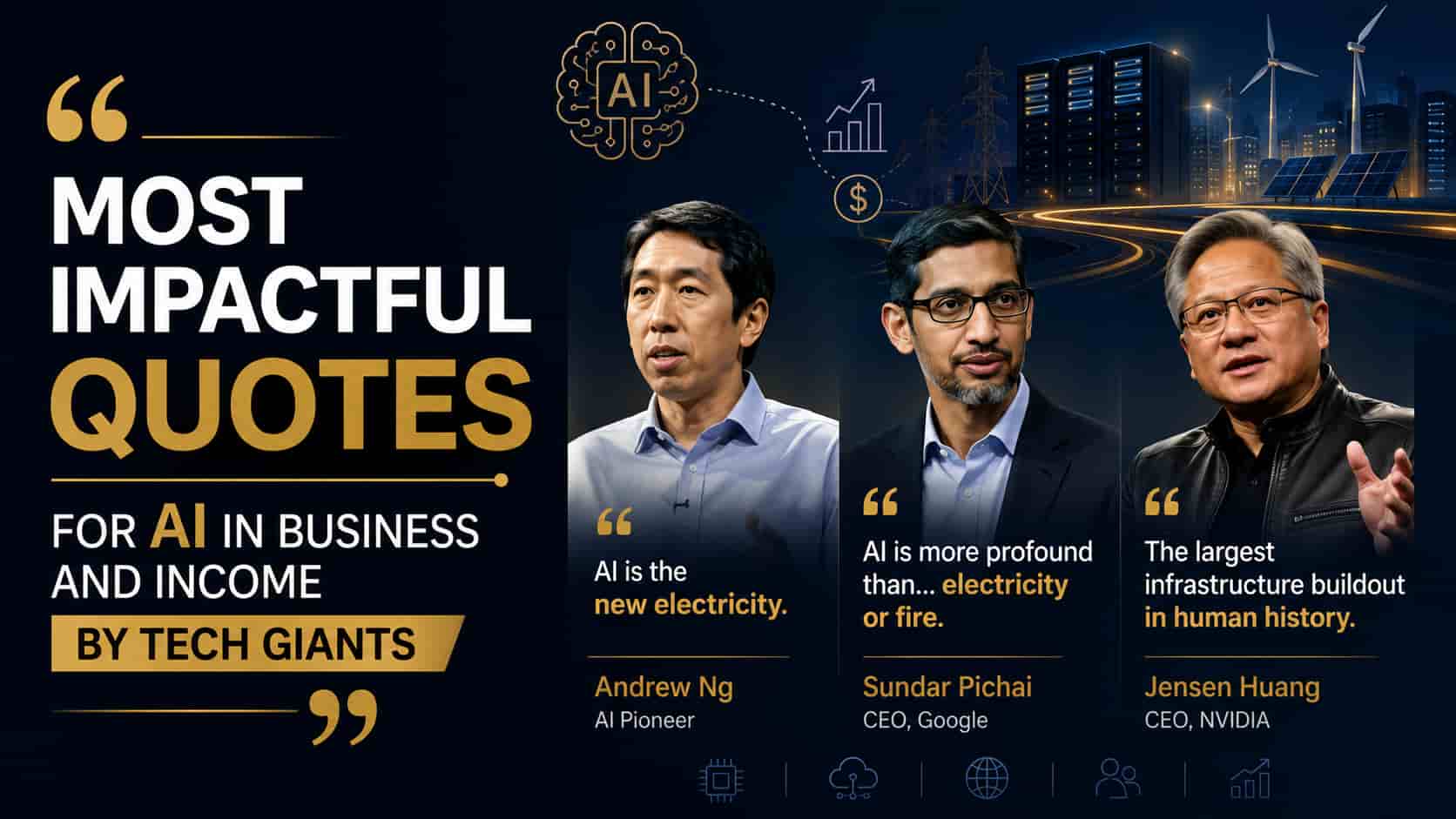
AI isn’t optional anymore — it’s the new electricity, quietly running through every industry whether you’ve plugged in or not. That line isn’t mine. It belongs to Andrew Ng, the AI researcher who co-founded Google Brain, and it’s stuck around for a reason: it captures exactly how invisible yet essential AI has become to modern business.
If you’re an entrepreneur or small business owner anywhere from Guwahati to Bengaluru to a small office in Boston, you’ve probably felt the pressure building — the sense that AI for business and income isn’t a future trend to plan for someday, but a shift already reshaping who wins and who gets left behind. So what are the people actually building this technology saying about it? And more importantly, what should you do with what they’re saying?
That second question is really the point of this piece. Anyone can collect quotes and slap them on a motivational poster. What’s harder — and far more useful — is pulling apart what a Sundar Pichai or a Jensen Huang statement actually implies for a solo entrepreneur trying to grow a small business, not a trillion-dollar company.
That’s what we’re doing here: real, verified statements from the people steering the AI industry, followed by a plain-language translation of what each one means for your business and your income. Let’s get into it.
In this article
AI as Infrastructure and Opportunity
Three tech leaders, three different metaphors, one shared point: AI isn’t a feature anymore; it’s foundational.
Andrew Ng’s “new electricity” line remains the cleanest way to say it — a resource so fundamental that entire industries will eventually run on it without a second thought, the same way no restaurant owner today thinks twice about whether to plug in a refrigerator. Google CEO Sundar Pichai went even further in a widely reported 2018 interview, calling AI’s importance “more profound than… electricity or fire.”
And on the infrastructure side, Nvidia CEO Jensen Huang has repeatedly described the current AI buildout — the data centers, chips, and power plants — as “the largest infrastructure buildout in human history,” a phrase he’s used at Davos and in multiple interviews throughout 2026 to describe the sheer scale of investment pouring into AI right now.
So what does this mean for you? If the biggest names in tech agree AI is foundational infrastructure, then treating it as an occasional tool rather than a core part of how you operate is like running a 2026 business without a website. You don’t have to build the infrastructure — Nvidia, Google, and a dozen others are doing that. You just have to actually plug into it.
AI for Competitive Advantage
This is where the stakes get personal. Former IBM CEO Ginni Rometty‘s now-famous line puts it bluntly: “AI will not replace humans, but those who use AI will replace those who don’t.” It’s one of the most repeated lines in business circles right now, and for good reason — it reframes the fear from “will AI take my job or business” to the far more useful question, “who’s already using AI against me?”
Nvidia’s Jensen Huang echoed the same idea more pointedly at the Milken Institute’s Global Conference in 2025, telling the audience, “you’re going to lose your job to someone who uses AI” — not to AI itself. Meanwhile, Accenture’s leadership has pointed to research showing that businesses skipping AI-driven innovation risk falling meaningfully behind competitors who don’t, across virtually every sector they’ve studied.
So what does this mean for you? The threat was never really the technology — it’s the entrepreneur down the street (or across the world, competing for the same online customers) who picked it up six months before you did.
AI as Income Multiplier
Here’s where things get genuinely exciting for anyone building something of their own. OpenAI CEO Sam Altman has talked publicly — including in an interview with Reddit co-founder Alexis Ohanian — about a running betting pool among his tech CEO friends for when the first one-person, billion-dollar company will appear, something he’s said “would have been unimaginable without AI” and now, in his words, will happen.
Entrepreneur and investor Mark Cuban has said in interviews that he expects the world’s first trillionaires to be people who master AI and apply it in ways nobody’s thought of yet — a genuinely striking claim from someone who’s spent decades evaluating businesses for a living.
Andrew Ng, back again, sums up the current moment simply: AI, he’s noted, is already “creating tremendous economic value” — not someday, but right now, in the businesses already using it.
So what does this mean for you? You don’t need a hundred employees to build something big anymore. You need the right tools, real context you feed into them, and the willingness to actually learn them well enough that they compound rather than just answer the occasional question.
AI Augmentation, Not Replacement
Not every leader is framing this as a race. Microsoft CEO Satya Nadella has spoken repeatedly about AI’s role in amplifying — not replacing — human strengths like creativity and judgment, a theme he’s returned to across interviews and keynotes for years. Sundar Pichai has struck a similar note, describing AI’s future as being about augmenting human capability rather than substituting for it.
So what does this mean for you? The entrepreneurs who thrive won’t be the ones who let AI run their business unsupervised — they’ll be the ones who let it handle the grind so they can focus on the judgment calls only a human can make.
AI as Business Imperative
Salesforce chair and CEO Marc Benioff has called generative AI one of the most significant technology shifts of his career, and Satya Nadella has argued for years that AI isn’t just an engineering concern — it’s reshaping how every part of a business runs, from marketing to operations to customer service.
So what does this mean for you? If AI touches every function of a large enterprise, it touches every function of a one-person business too — you just don’t have a department to hand it off to. You are the department.
What This Means for Entrepreneurs in India
For business owners in Guwahati, Assam, and across India, these quotes aren’t just inspirational wallpaper — they map onto a very real opportunity. India’s cost-of-entry advantage in services, combined with widely available free and low-cost AI tools, means the “using AI vs. not” gap Rometty and Huang describe is one of the most level playing fields Indian entrepreneurs have ever had against bigger, better-funded competitors abroad. A one-person consultancy in Guwahati can now produce marketing content, handle customer queries, and analyze its own sales data with roughly the same tools available to a team in San Francisco.
The mistake most people make interpreting these quotes? Reading them as hype about some far-off future, rather than as a description of what’s already happening in their own market this year. The second most common mistake: assuming “using AI” means buying an expensive enterprise tool, when in reality, most of the entrepreneurs actually pulling ahead started with free tiers of ChatGPT, Claude, or Gemini and a genuine habit of using them daily. A real-world example worth noting: small e-commerce sellers across Indian marketplaces have started using AI tools simply to write better product descriptions and respond to customer questions faster — a small, unglamorous change that directly moves conversion rates and review scores.
Your Actionable Takeaways for This Week
Reading quotes is inspiring. Acting on them is what actually moves your income. Here’s where to start:
- Pick one workflow to automate this week — customer FAQs, social media captions, or invoice follow-ups are good starting points.
- Identify the task eating 5+ hours of your week and hand at least half of it to an AI tool.
- Experiment with free tools first — ChatGPT, Claude, and Gemini all offer usable free tiers before you spend a rupee or a dollar.
- Build AI literacy across your team, not just your own workflow — Rometty’s quote applies to everyone on your payroll, not just you.
- Focus on augmentation, not replacement — use AI to handle the repetitive 80%, and spend your saved time on the judgment-heavy 20% only you can do.
- Revisit your pricing and offerings — if AI has cut your production time in half, you may be able to serve more clients or lower your price to win more of them.
- Set a weekly 30-minute “AI experiment” block — just to try one new feature or tool you haven’t touched yet.
Conclusion: The Window Is Open — For Now
Every quote in this piece points to the same uncomfortable truth: the advantage of adopting AI early doesn’t last forever. Right now, in 2026, using AI well is still a genuine differentiator — the gap between businesses that have built it into their daily operations and those still treating it as a novelty is wide enough to actually win or lose customers over. In a few years, it’ll simply be the cost of staying in business — table stakes, not an edge, the same way having a mobile-friendly website stopped being a differentiator a decade ago.
The entrepreneurs who’ll look back on this moment as their turning point are the ones who stopped reading about AI and started actually running their business on it. Not perfectly, not all at once — just one workflow, one habit, one week at a time. Which one will you be?
Read Next: How to Use AI to Grow Your Business and Income — practical tools and strategies to put these quotes into action.
10 Wealth-Building Quotes From Millionaires (With Guided Prompts) — Practical business mindset stated in quotes by millionaires.