We have many words for protecting the Earth. We have very few for loving her.
We speak of conservation, sustainability, and climate action. These words matter, and the work behind them is urgent. But most of them begin with a warning. They tell us what we will lose if we fail. Very few begin with what we already have, and with what that gift asks of us.
In this article
This manifesto offers two words that begin with love.
The definitions
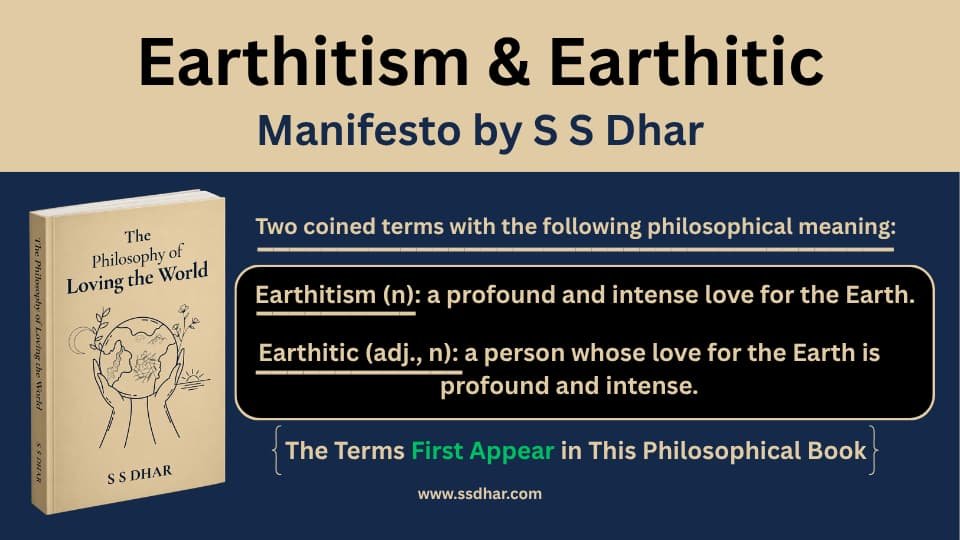
Earthitism (noun): a profound and intense love for the Earth, expressed through emotional attachment, reverence, care, and a sense of responsibility toward our planet.
Earthitic (adjective or noun): relating to Earthitism; especially, a person whose love for the Earth is profound and intense.
I coined both words for my book The Philosophy of Loving the World, where they first appear in print. The book was first internationally published on 17 October 2026. From then on, the terms are publicly available with the specific philosophical meaning mentioned in the book and in the article.
Why a new word was needed
A person can protect something out of duty and never love it. A person can also love something and, without thinking, harm it. Earthitism joins the two. It says that real care for the planet begins in the heart and shows itself in how we live.
Think of how we treat our mothers. We do not need a law to remind us to love them. We do not keep a ledger of what they gave and what they are owed. We feel the debt in our bones. Earthitism asks us to feel the same toward the one who holds us all, though she bore none of us in her womb.
What an earthitic person believes
1. The Earth is not a resource.
A resource is something we use up. A mother is someone who raised us. The soil, the atmosphere, and the oceans are not outside us. They are the body we walk upon and the air we breathe in. To treat them only as supplies is to forget where we came from.
2. Her gifts are easy to forget because they are free.
Air and water, which we cannot live without, cost almost nothing while they last. Scarcity decides what we value, and so we notice a gift only when it begins to run out. The earthitic person tries to value it while it lasts.
3. What we do to her, we do to ourselves.
Her blood is our water. Her breath is our wind. Her soil feeds our children. When we desecrate her, the loss comes back to us, in thirst, in hunger, and in a poorer life for those who come after.
4. She shows no favorites.
Every child is hers, in every country and every religion, on every part of her surface. She does not know our borders. This is why love for the Earth cannot stop at a national line. It is the one love that belongs to everyone at once.
5. Her patience is large, but not endless.
She bears our curses and still gives mercy. But the same Earth that gives so freely can also show her anger, in the flood that is slow to recede and the volcano that is quick to rise. An earthitic person knows that her forbearance is a gift, not a guarantee.
6. Love must become action.
Feeling is where Earthitism starts, not where it ends. The earthitic person moves from awareness to care, and from care to responsibility.
How to live it
Earthitism does not require a title or a movement. It asks for small, daily acts of attention.
- Notice the ground. Stand somewhere quiet and feel what is holding you up.
- Give back more than you take. Plant, repair, reuse, and refuse what you do not need.
- Teach a child where water comes from. Love is passed on through the stories we tell.
- Speak when she is harmed. Do it gently, and without contempt for those who have not yet noticed. Many people simply have not been taught to see her as a mother.
- Keep her at peace all day long. Earth Day is not a single date on the calendar. It is a way of living.
The earthitic one
In my poem “Earthitism,” I wrote that when earthitism is born in the soul, an eternal love flows through the heart in every direction. The earthitic one, lost in the abyss of sorrow and delusion, always finds refuge in her embrace, and she protects with her love every step forward.
I believe this is true in both directions. The Earth protects those who love her, and love for the Earth protects us from despair. In a world full of noise and argument, there is one thing every human being can agree on: we all live on the same ground, under the same sky, in the same lap.
Concluding Words for the Earth
We honor the mothers who bore us. We give far less to the one who holds us all. We give her our bodies only when we die. She deserves more while we live.
This is what Earthitism asks: that we love the Earth while she can still hear us, not only after she is gone. If you already feel this love, you are earthitic, whether or not you ever used the word. If you do not yet feel it, begin where you are. Look at the sky, touch the soil, and listen to the water. Love tends to follow attention.
Love her first. The rest will follow.
Earthitism and Earthitic were coined by S S Dhar and first appear in his book The Philosophy of Loving the World. Order your copy on Amazon.com, Amazon.co.uk, Amazon.ca, Amazon AU, Amazon.in
Few Important Questions
What does Earthitism mean?
Earthitism is a profound and intense love for the Earth, expressed through emotional attachment, reverence, care, and a sense of responsibility toward our planet. It starts with love, the way a person feels toward a mother, and then grows into action. The word was coined by S S Dhar and first appears in his book The Philosophy of Loving the World.
Who is an Earthitic person, and how is it different from being an environmentalist?
An earthitic person is someone whose love for the Earth is profound and intense. Environmentalism often begins with concern about loss, such as pollution, scarcity, or climate risk. Earthitism begins with love and attachment, and care follows from that. The two are not opposed. An environmentalist can be earthitic, and an earthitic person will usually care about the environment. The difference is where the motivation starts.
How can I practice Earthitism in daily life?
You do not need a title or a group. Start with small acts of attention: notice the ground and the air around you, give back more than you take, reuse and refuse what you do not need, teach a child where water comes from, and speak up gently when the Earth is harmed. The idea is to treat the Earth as a mother who holds us all, not as a supply to be used up.
Other works by S S Dhar